· marketing · 6 min read
The Ethical Dilemma of Automation: Is Zapier Killing Personal Touch in Marketing?
An in-depth look at how marketing automation platforms like Zapier shift the balance between scale and authenticity - with practical rules and a checklist to keep the human touch where it matters.
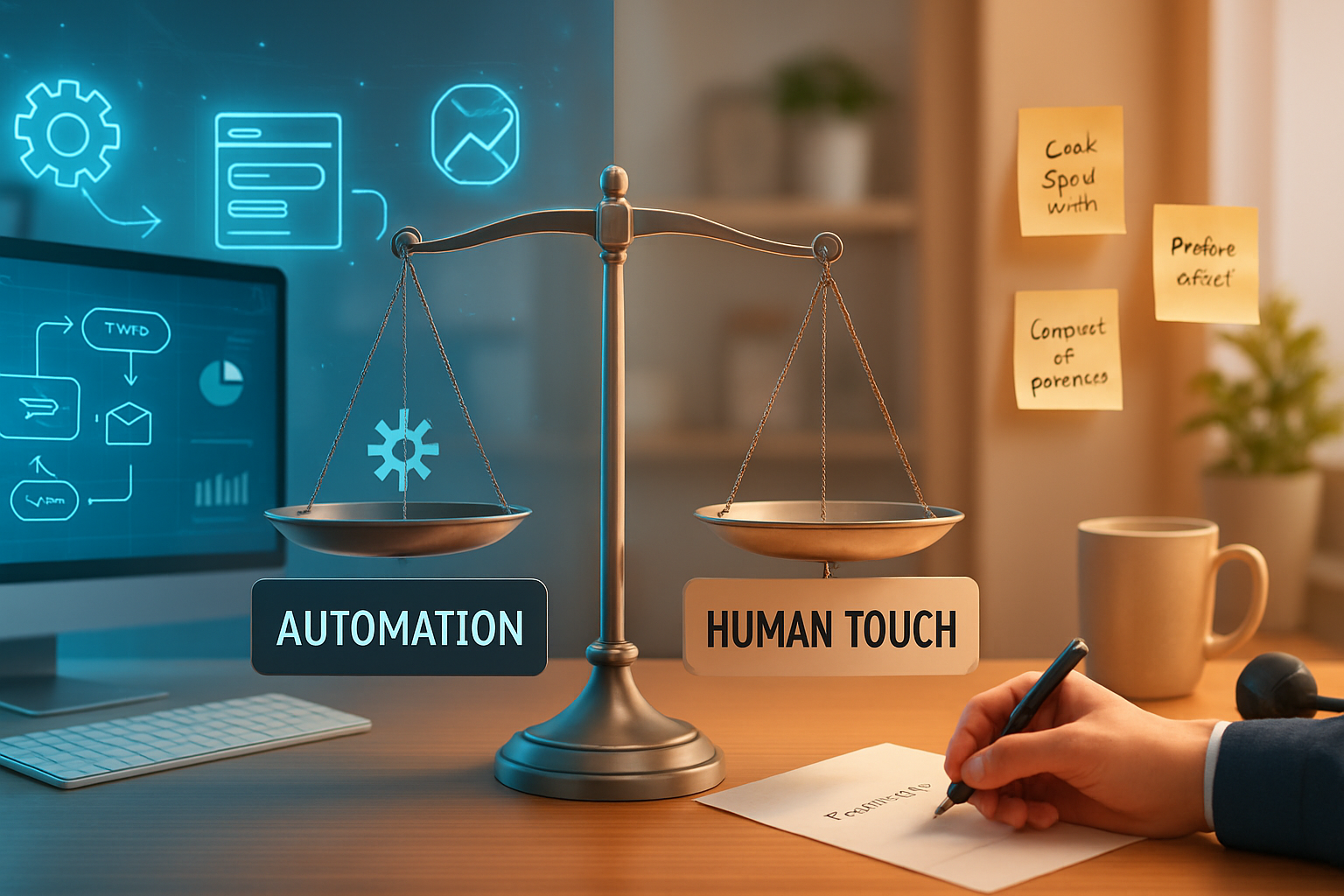
Outcome first: after reading this you’ll be able to decide confidently where automation helps your marketing - and where it harms relationships - with a concrete decision framework, measurable signals to watch, and a practical checklist you can use in your next Zap.
Why this matters now
Automation tools like Zapier let you connect apps, push messages, and trigger follow-ups across platforms with almost zero friction. They scale faster than hiring. They reduce errors. They free time. They also make it trivial to replace a human interaction with a machine-driven one.
That trade-off is the ethical dilemma. Scale versus care. Speed versus sincerity.
You can keep both. But only if you choose intentionally.
The promise and the problem of automation in marketing
Automation delivers three clear benefits:
- Consistency - rule-based follow-up ensures no lead falls through the cracks.
- Scale - you can reach thousands with consistent workflows.
- Efficiency - routine tasks move off human plates.
And three common harms when used without guardrails:
- Erosion of perceived authenticity. Messages that feel generic lower trust.
- Context collapse. Triggers miss nuance; the timing or channel can be wrong.
- Consent and privacy risks when data and triggers aren’t carefully controlled.
Zapier - and platforms like it - is a neutral connector. But neutral tools enable both humane automation and careless automation. See Zapier’s own guides for getting automation right for a primer on capabilities and best practices: https://zapier.com/learn/automation/.
An ethical framework: When to automate, when to humanize
Use a simple two-axis decision framework: Customer Value (low → high) vs. Interaction Sensitivity (low → high).
- Low value, low sensitivity - Automate. Routine confirmations, receipts, simple scheduling.
- High value, low sensitivity - Hybrid. Personalize templates and add manual review for big moves (e.g., renewal offers for high-value accounts).
- Low value, high sensitivity - Avoid automation. Personal apologies, sensitive refunds, or reputation-affecting actions should be human-handled.
- High value, high sensitivity - Human-first. Account transitions, complaints that could cost revenue, or major onboarding steps need real people.
Put another way: use a funnel lens. At the top - awareness and basic nurture - automation wins. At the bottom - negotiation, service recovery, complex onboarding - humans matter more.
Where automation tends to erode personal touch (and how to prevent it)
- Generic personalization tokens alone
- Problem - A first-name merge token doesn’t make it personal.
- Fix - Combine tokens with contextual triggers (e.g., reference a recent page visit, recent purchase, or CRM note). Add an option to route to a human if the contact has unusual activity patterns.
- Over-frequency and wrong timing
- Problem - Multiple zaps can create message cascades. Recipients feel spammed.
- Fix - Implement throttling rules, global suppression windows (no more than X emails per Y days), and activity-based pauses.
- Over-reliance on conditional logic without human review
- Problem - Complex IF/THEN trees become brittle and miss nuance.
- Fix - Insert manual checkpoints for high-impact branches (e.g., “If lifetime value > $5k, pause zap and notify account manager to review”).
- Treating automation as a substitute for consent and transparency
- Problem - Automations can pull data and contact people in ways users don’t expect.
- Fix - Make data flows transparent in privacy policies and preference centers. Honor opt-outs and maintain a single source of truth for consent.
Practical Zap designs that keep human touch
Below are three practical flows with notes where to add human involvement.
Example 1 - New lead capture (Top of funnel)
- Form submission (Typeform) → Zapier step records lead to CRM.
- CRM triggers email nurture sequence (automated, templated).
- Human touch - After 3 automated touches, if lead clicks pricing or requests a demo, route to SDR with context and a transcript snippet.
Why this keeps human touch: A human has the chance to intervene when intent is high.
Example 2 - Support escalation (High sensitivity)
- Support ticket labeled “escalation” → Zap creates internal alert.
- Zap pauses any automated satisfaction surveys for that customer.
- Human touch - Assign to a triage agent within 30 minutes and require a short human reply within 24 hours.
Why: Automation speeds routing but doesn’t replace ownership.
Example 3 - Renewal warning for high-value customers
- Renewal date approaching → Zap notifies account manager and sends a soft, automated reminder.
- Zap waits 72 hours for account manager action.
- If manager hasn’t acted, escalate to director and pause further automated marketing for that account.
Why: Automation triggers awareness; humans negotiate conversions.
Measuring whether automation is killing the personal touch
Watch these signals and set thresholds you’ll treat as red flags:
- Reply rate and qualitative content - Are replies shorter and more negative after automation changes?
- NPS and CSAT trendlines - Drops after automation rollouts are a warning.
- Conversion velocity and churn - Faster automated funnels that produce lower retention need review.
- Complaint rates and unsubscribe velocity - Spikes suggest overly aggressive automation.
- Human escalation ratio - If human escalations rise because automation keeps failing cases, your automation is harming experience.
Make experiments explicit. A/B test automations with a clear holdout group that receives human contact and compare outcomes.
Legal and privacy guardrails
Automation multiplies risk if legal and privacy basics are not enforced at the workflow level.
- GDPR and consent - Make sure your automations respect lawful bases to process data. See GDPR basics:
- Email rules - Honor unsubscribes and suppression lists centrally. Follow CAN-SPAM:
- Data minimization - Don’t forward or expose more PII than necessary in zaps and notifications.
Design zaps with central consent checks and a canonical suppression list.
Organizational shifts that preserve authenticity
- Ownership - Give a person or team responsibility for experience outcomes - not just uptime.
- Playbooks - Build clear escalation playbooks that overlay automated flows.
- Training - Teach people to read automation outputs and to step in gracefully. Automated alerts should summarize context, not dump raw logs.
- Regular audits - Quarterly reviews of zaps and automation rules. Include anonymized customer feedback in the audit.
A short checklist before you push a new automation
- Does the automation respect consent and privacy? (Yes / No)
- Have you mapped which interactions are high-sensitivity? (Yes / No)
- Is there a human checkpoint for high-value or ambiguous cases? (Yes / No)
- Are throttling and suppression rules in place? (Yes / No)
- Is there a rollback plan with metrics to monitor? (Yes / No)
- Has legal reviewed data flows that cross borders? (Yes / No)
If you answered “No” to any question, pause and fix it.
Final thoughts - the real ethics question
Automation is not the moral actor. People are. Tools like Zapier enable scale and consistency, and they also enable ethical neglect when humans abdicate judgment.
Use automation to amplify what you do well: speed, reliability, and relevant personalization. Avoid using automation to excuse a lack of care.
Make customer dignity a metric. Measure it. Protect it. And always build your automations so that a person can step in, understand the context, and restore the human connection.
Automation should expand human capacity, not replace human responsibility.
References
- Zapier - Learn automation: https://zapier.com/learn/automation/
- Nielsen Norman Group - Personalization and UX: https://www.nngroup.com/articles/personalization/
- GDPR overview: https://gdpr.eu/
- CAN-SPAM compliance guide (FTC): https://www.ftc.gov/tips-advice/business-center/guidance/can-spam-act-compliance-guide-business