· marketing · 6 min read
The Controversial Truth About Optimizely: What Most Marketers Won't Tell You
Optimizely is powerful - but it's not a magic wand. This post exposes the common misconceptions and controversial tactics marketers use, reveals the real pitfalls, and gives a practical playbook so your experiments produce reliable, business-driving results.
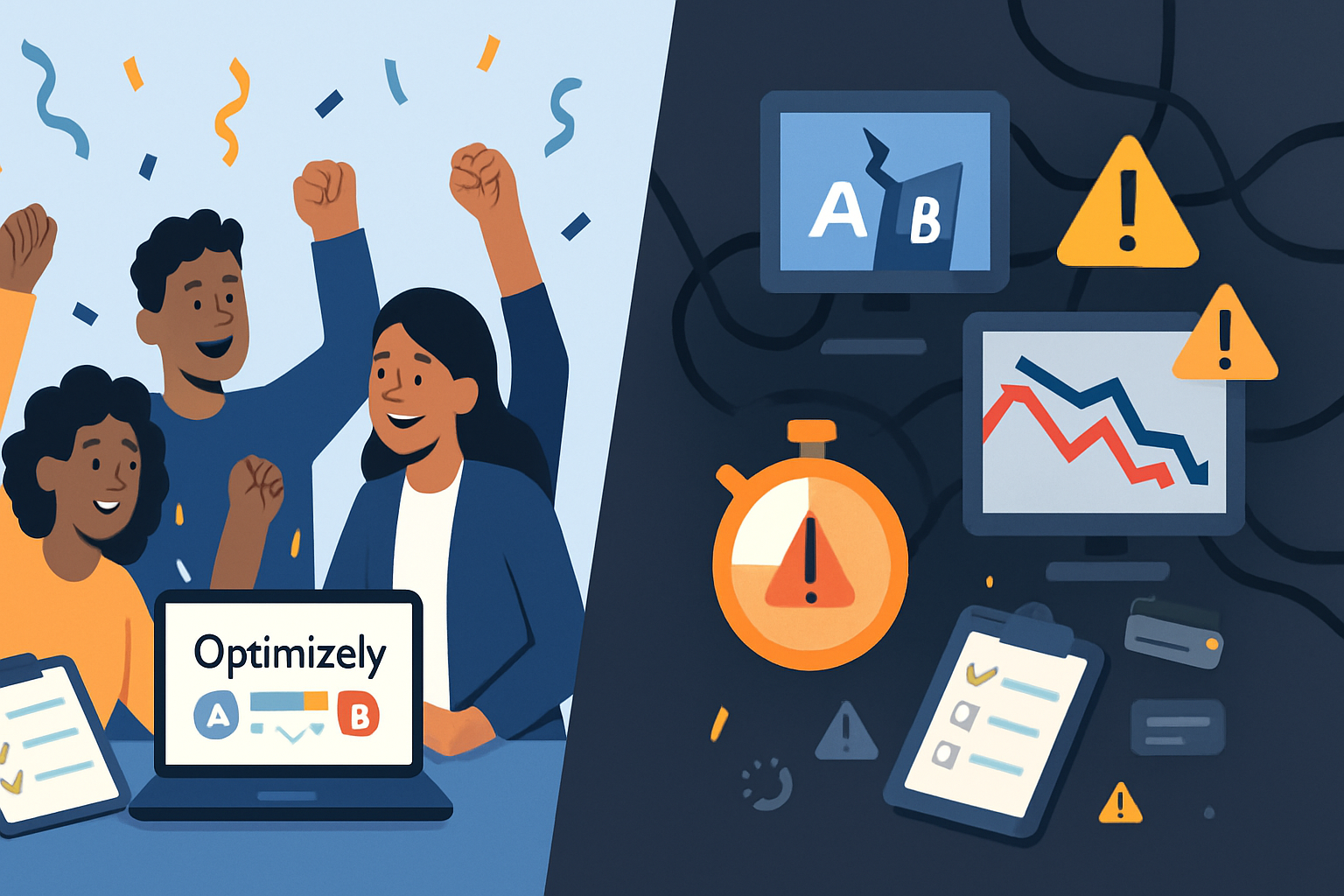
Outcome-first: run experiments that actually move business metrics - not vanity lifts. Read this and you’ll know which Optimizely traps to avoid, which counterintuitive rules to follow, and how to design experiments that survive scrutiny and scale.
Why this matters right now
Optimizely is often sold as the simplest route to conversion wins. It makes testing accessible. It also makes bad habits easy to repeat. Short-term “wins” can hide long-term losses. False positives become company lore. Tests interfere with each other. The result: wasted budget, mistrust of experimentation, and decisions based on noise.
That’s avoidable. But only if you understand the controversial trade-offs people rarely admit.
What Optimizely is - and what it isn’t
- It’s a powerful experimentation and feature-flagging platform with both web and server-side SDKs. Optimizely’s docs explain the core features and Stats Engine.
- It’s not an automatic conversion factory. The tool executes tests; it does not replace research, hypotheses, or measurement discipline.
- It’s not a full analytics stack. Using Optimizely as your only source of truth can hide long-term effects and attribution issues.
If you expect a button click test to translate into sustained revenue without follow-up measurement, you’ll be disappointed.
Common misconceptions (and the reality)
Misconception: “A/B testing will always find wins.” Reality: Most tests are neutral or inconclusive unless you start with a strong hypothesis and meaningful metric.
Misconception: “Stop the test when you see a winner.” Reality: Peeking inflates false positives. Optimizely’s Stats Engine reduces this risk but does not eliminate poor stopping rules. See why sequential sampling is tricky in practice here.
Misconception: “You can run infinite concurrent experiments.” Reality: Interference between tests (mutual impact on the same users or funnels) biases results. Design for orthogonality or use holdouts.
Misconception: “Personalization = experimentation.” Reality: Personalization without randomized experiments is targeting, not causal inference. Personalization plus experimentation is powerful - but only if you handle overlap correctly.
Controversial strategies marketers use (and why they’re risky)
Cherry-picking short-term KPIs - Highlighting lift in an engagement metric while ignoring CAC, CLTV, or retention. This creates perverse incentives. Short-term lifts often vanish.
Stopping early after a spike - Some marketers stop tests as soon as they see a favorable p-value. This practice is a textbook source of false discovery.
Relying solely on the platform’s dashboard - The Optimizely dashboard is friendly. But it’s not your full audit trail. Export raw events, cross-check with your analytics, and store experiment metadata in your data warehouse.
Using Optimizely as a personalization engine without experiments - That turns experimentation into an opinion-driven personalization program, not evidence-based optimization.
Inflating sample size to chase significance - Running a test for longer to “get significance” rather than revisiting the hypothesis or boosting effect size via better treatments.
Over-testing trivial changes (button color wars) - Micro-optimizations can be tempting but don’t scale. They consume test real estate and distract from higher-impact funnel changes.
Real pitfalls - and concrete fixes
Pitfall: Peeking and early stopping
- Fix - Pre-register stopping rules and sample sizes. Use sequential methods properly or rely on Optimizely’s Stats Engine while understanding its limits.
Pitfall: Multiple comparisons and false discoveries
- Fix - Limit concurrent tests on the same user pools or adjust for multiple comparisons. Prioritize tests by expected impact (use ICE - Impact, Confidence, Ease).
Pitfall: Test interference
- Fix - Use mutually exclusive audiences or factorial designs. Use holdout groups where necessary.
Pitfall: Poor metric selection
- Fix - Choose a single primary metric tied to business outcomes. Use guardrail metrics (e.g., revenue per visitor, retention) to capture negative side effects.
Pitfall: Data mismatch between Optimizely and analytics
- Fix - Instrument events consistently. Sync experiment IDs to your analytics and warehouse. Reconcile differences before making decisions.
Pitfall: QA and flicker
- Fix - Use server-side experiments for critical flows. For client-side, preload changes to reduce visual flicker. Build robust QA steps into rollout.
Pitfall: Treating a tool as a team
- Fix - Invest in experimentation process, education, and governance. Tools enable change; processes scale it.
References for the statistical/bias risks: Evan Miller’s AB testing primer is a practical resource on sequential analysis and peeking [https://www.evanmiller.org/ab-testing/]. For behavioral pitfalls and test design, see a practical list of common testing mistakes at CXL [https://cxl.com/blog/ab-testing-mistakes/].
Your practical playbook - step-by-step
- Start with research, not ideas. Use analytics and qualitative research to surface friction points.
- Write a clear hypothesis - “If we [change X] for [audience Y], then [metric Z] will improve by [expected amount].”
- Choose a primary business metric. Add 1–2 guardrail metrics.
- Calculate minimum sample size for the expected lift and desired power. Don’t guess.
- Pre-register stopping rules. If you’ll use sequential methods, document the approach.
- Isolate audiences to avoid interference. Use holdouts for downstream effects.
- Instrument and export raw data. Sync experiment IDs with your warehouse and analytics tool.
- QA thoroughly on all device types. Check for flicker and performance regressions.
- Run the test until the planned sample size or stopping rule is reached. Avoid peeking-driven decisions.
- Analyze comprehensively - check segments, long-term metrics, and downstream effects before calling a winner.
- Roll out with feature flags and holdouts. Monitor post-launch impact.
A short checklist you can copy into a ticket:
- Hypothesis written
- Primary metric defined
- Sample size & stopping rule set
- Audience orthogonality ensured
- Events instrumented & exported
- QA passed on desktop/mobile
- Guardrails monitored
Two short examples
Example 1: The “big lift” that vanished A retail site ran an experiment that increased add-to-cart rate by 8% on a short-term campaign. They touted the win. Later, average order value dropped and returns rose. Because they tracked a single short-term KPI, the net revenue per visitor fell. The fix would have been to include revenue-per-visitor and returns as guardrails, plus a post-launch holdout to confirm sustained lift.
Example 2: Interfering tests A growth team ran multiple concurrent tests in the checkout flow. Treatments overlapped and users experienced combinations the team hadn’t planned for. Results were noisy and non-reproducible. The solution: enforce test isolation or run factorial experiments that explicitly test combinations.
When to consider alternatives or complementary approaches
- If the site’s primary problem is product-market fit, qualitative research and experiments outside of Optimizely (e.g., prototypes, pricing experiments via landing pages) can be faster.
- For performance-sensitive flows (login, checkout), prefer server-side experimentation with feature flags to avoid client-side latency.
- If your team lacks statistical expertise, pair analysts with data scientists or hire contractors to validate experiment design.
Final takeaway
Optimizely is powerful - but only as powerful as your goals, instrumentation, and discipline. The controversial truth most marketers won’t admit is simple: the tool exposes your process, it doesn’t fix it. Tighten your hypotheses. Lock down your metrics. Treat experiments like science, not hacks. Do that, and the wins you get will be real, reliable, and repeatable.