· marketing · 7 min read
The SEO Power Couple: How to Use Ahrefs with Google Analytics for Maximum Impact
Learn how to combine Ahrefs’ competitive data and backlink intelligence with Google Analytics’ behavioral and conversion data to prioritize SEO work, measure ROI, and unlock growth opportunities. This guide gives step‑by‑step workflows, example scripts, dashboard ideas, and a 90‑day action plan.
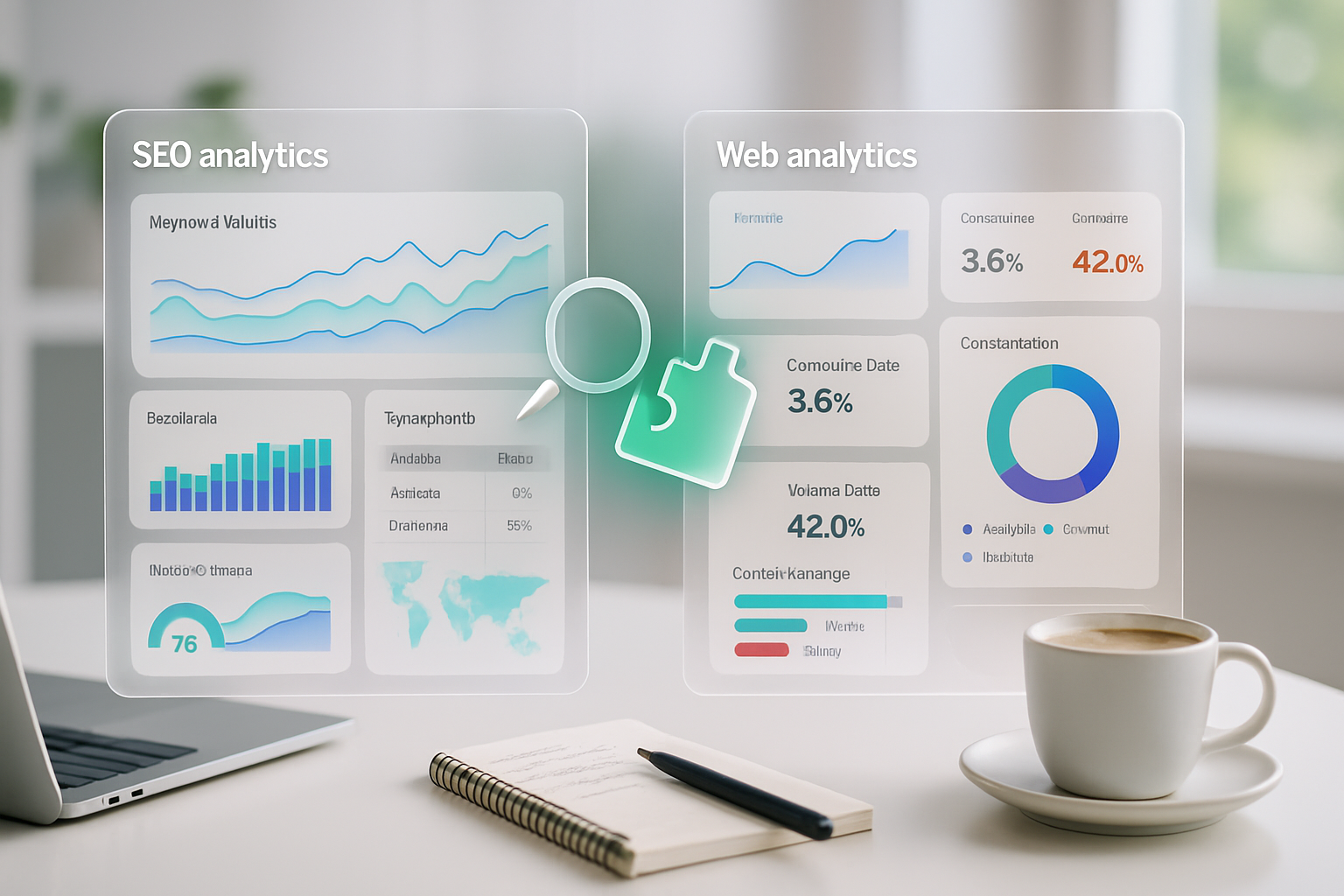
Outcome first: integrate Ahrefs with Google Analytics and you will stop guessing which SEO tasks move the needle. You’ll know which keywords actually bring converting users. You’ll know which backlinks are worth chasing. You’ll find quick wins that lift traffic and conversions in weeks, not months.
This guide shows exactly how to create that synergy. Practical workflows. Scripts and spreadsheet formulas you can run today. Dashboard ideas you can hand to a stakeholder. Let’s get into it.
Why combine Ahrefs + Google Analytics?
Short answer: Ahrefs sees search positions, backlink sources, and competitive context. Google Analytics sees user behavior, conversions, and traffic quality. Bring them together and you get both intent and impact.
- Ahrefs tells you what rank and who links to you. It shows keyword difficulty, estimated search volume, and backlink details. See Ahrefs docs: https://help.ahrefs.com/
- Google Analytics tells you whether people who land from organic actually engage and convert. See Google Analytics docs: https://support.google.com/analytics/
Individually they’re useful. Together they’re decisive.
Prerequisites and considerations
- Access - You need at minimum Read permissions in Google Analytics and an Ahrefs account with export capabilities. If you plan to automate, a service account or OAuth token is required.
- GA4 vs Universal Analytics - GA4 is the current Google standard. If you’re still on Universal Analytics, note some naming differences (events vs goals, sessions vs users). The workflows below work with both; adapt metric names accordingly.
- URL consistency - Use canonical or final URLs to join datasets reliably. If your CMS serves multiple URL variants, normalize before merging.
How to connect (conceptual steps)
- Ensure GA property is collecting organic traffic and landing page data correctly.
- In Ahrefs, use the export features for - Top Pages, Organic Keywords (per domain or page), and Referring Domains/Backlinks. Export as CSV.
- Export GA reports for the same date ranges - Landing Page performance (sessions, users, conversions), and Acquisition -> Channels -> Organic Search data. Export as CSV or extract via the API / BigQuery for GA4.
- Merge datasets on landing page URL (or keyword where applicable). You can do this in a spreadsheet, Python/pandas, or in a BI tool like Google Looker Studio.
You generally authorize Ahrefs to read Search Console/Analytics if you want automated pulls inside Ahrefs; otherwise manual export works fine.
Workflow 1 - Prioritize pages by ranking vs result quality (quick wins)
Goal: Find pages that rank well or have many keyword opportunities but deliver poor conversion/value.
Steps:
- From Ahrefs - export your domain’s Top Pages and the Organic Keywords report (filter to target country). For each page, capture organic keywords, position, and estimated traffic.
- From GA - export Landing Page performance for the same period with metrics: sessions, bounce rate, average session duration, and conversions/goal completions.
- Merge on landing page URL.
What to look for:
- Pages with high Ahrefs estimated traffic or many ranking keywords, but low GA conversions or high bounce rate. These are optimization candidates (meta/title/CTA/pagination/UX).
- Pages with poor rankings but high conversion rate - low-hanging CRO wins - improve rankings (on‑page + internal links) to scale conversions.
Spreadsheet formula example (Google Sheets):
- Use VLOOKUP or INDEX/MATCH to pull GA metrics into the Ahrefs export after both are normalized to canonical URLs.
Example (assuming Ahrefs export in Sheet1 and GA export in Sheet2):
=INDEX(Sheet2!$B:$B, MATCH(A2, Sheet2!$A:$A, 0))Where A2 is the page URL in Sheet1 and Sheet2 column B is sessions.
Python/pandas merge example (quick):
import pandas as pd
ah = pd.read_csv('ahrefs_top_pages.csv')
ga = pd.read_csv('ga_landing_pages.csv')
# Normalize columns to the same canonical URL name first
merged = ah.merge(ga, left_on='URL', right_on='landingPage', how='left')
merged.to_csv('merged_ah_ga.csv', index=False)
Action: Create a prioritized list: high Ahrefs traffic estimate + low GA conversions = optimize CTAs and UX. Low Ahrefs estimates + high GA conversions = boost rankings (on‑page and internal linking).
Workflow 2 - Calibrate click estimates and surface tracking issues
Ahrefs provides estimated organic traffic while GA provides observed sessions. Mismatches are normal. But when the gap is large, it reveals either tracking gaps or metadata issues.
Steps:
- For each page, compute the ratio - ObservedSessions / AhrefsEstimatedTraffic.
- Flag pages where ratio < 0.3 or > 2.0.
Interpretation:
- Observed << Estimated - check tracking (missing GA snippet, blocked scripts, canonical mismatch, redirect loops). Also check search intent mismatch - page might rank for non‑converting query terms.
- Observed >> Estimated - Ahrefs underestimates for long‑tail keywords or recent ranking improvements. Consider expanding Ahrefs crawl range or re-evaluating keyword list.
Formula example:
DiscrepancyRatio = GA_sessions / Ahrefs_estimated_trafficIf ratio < 0.3 -> audit tracking and UX. If ratio > 2 -> consider promoting the page to capture more intent via internal linking.
Workflow 3 - Backlink impact analysis (measure true ROI)
Goal: Link acquisition should lead to measurable traffic / conversions uplift. This method tests that.
Steps:
- From Ahrefs - export backlinks or referring pages with the date the link was first seen (first seen column).
- In GA - pull time series sessions and conversions for the target landing page(s) around the link acquisition date (e.g., 30 days before and after).
- Compare the before/after trend or run a simple difference-in-differences test versus a control page.
Practical tip: if many links arrive in a short window, aggregate by week.
Interpretation:
- Positive sustained uplift after link acquisition - backlink likely contributes to referral and organic authority - repeat similar outreach.
- No measurable uplift - the link may be low value for your goals, or the link points to a page that doesn’t convert. Redirect link strategy toward pages that convert.
Workflow 4 - Content Gap + Behavior = New opportunity prioritization
Use Ahrefs’ Content Gap (or Top Competitors -> Organic keywords) to find keywords competitors rank for that you don’t. Cross‑reference those keywords with GA to discover intent and demand.
Steps:
- From Ahrefs - run Content Gap for target competitors and export the keyword list.
- Add intent and search volume columns from Ahrefs.
- In GA - review landing pages that serve similar intent or have partial coverage. Identify pages with traffic for adjacent keywords.
- Prioritize gaps where:
- Search volume is meaningful.
- Competitor pages rank well but your pages have some traffic (indicating partial coverage).
Result: a focused content plan - create new pages or expand existing ones, target high-intent keywords first.
Workflow 5 - Find technical trouble spots using Ahrefs Site Audit + GA behavior
Ahrefs Site Audit finds crawl issues, {noindex}, slow pages, 4xx/5xx. GA reveals which of those pages still receive traffic.
Steps:
- Run Ahrefs Site Audit, export list of flagged URLs.
- In GA, pull sessions for those flagged URLs.
- Prioritize fixing issues on pages that still receive meaningful traffic or have conversion value.
Common wins: fix redirects for pages with sessions, restore pages accidentally set to noindex, fix slow pages with high bounce rates.
Dashboards and automation ideas
- Looker Studio (Data Studio) - connect GA and import Ahrefs CSVs via Google Sheets or BigQuery. Build a dashboard that shows top landing pages with Ahrefs rank and backlinks. Visualize discrepancy ratio and conversion uplift.
- BigQuery (GA4) - export GA4 to BigQuery. Use scheduled scripts to pull Ahrefs exports and perform joins in SQL for large sites.
- Alerts - schedule weekly jobs that compute the top 50 pages where Ahrefs shows rising keywords but GA conversions fall - send to content owners.
Example KPI set for C‑Level stakeholders
- Organic sessions (GA)
- Organic conversion rate (GA)
- Revenue from organic (GA ecommerce/revenue events)
- Number of ranking keywords in top 10 (Ahrefs)
- New referring domains (Ahrefs)
- Average Discrepancy Ratio (GA sessions / Ahrefs estimated traffic) - track over time
Sample 90‑day plan (what to do this quarter)
Weeks 1–2: Exports & baseline
- Export Ahrefs Top Pages, Organic Keywords, Referring Domains.
- Export GA landing pages and conversion data. Normalize and merge. Build a baseline sheet.
Weeks 3–6: Quick wins
- Fix top 10 pages with high Ahrefs traffic but low conversions (title/meta, CTA, internal links).
- Fix top 10 tracked technical issues from Site Audit that receive traffic.
Weeks 7–10: Content & link strategy
- Run Content Gap and prioritize 15 high-intent keyword pieces.
- Run targeted outreach for 10 pages that convert but lack backlinks.
Weeks 11–12: Measure & iterate
- Use the backlink impact workflow for pages targeted in weeks 7–10.
- Present a report with ROI - conversions attributed to organic improvements and backlink efforts.
Common pitfalls and how to avoid them
- Joining on inconsistent URLs - always normalize (strip query strings if appropriate, use canonical URLs).
- Chasing Ahrefs “estimated traffic” blindly - always validate with GA user-level/aggregate metrics.
- Ignoring seasonality - line up comparable date ranges and consider year-over-year when relevant.
- Over-attributing conversions to single backlinks - use control pages and multiple windows to confirm causality.
Tools & reference links
- Ahrefs Help Center: https://help.ahrefs.com/
- Google Analytics Help: https://support.google.com/analytics/
- Google Looker Studio: https://support.google.com/looker-studio/
Final takeaways - what you will achieve
When you combine Ahrefs’ external visibility (rankings, keywords, backlinks) with Google Analytics’ behavioral and conversion data, SEO moves from opinion to evidence. You’ll stop guessing which keywords to push, which backlinks to pursue, and which pages to optimize. You’ll focus spend on activities that demonstrably drive users and revenue. Short-term wins and long-term authority - both become measurable.
Start with a single merged export this week. Prioritize five pages. Fix them. Track lift. Repeat.