· marketing · 9 min read
Ahrefs vs. SEMrush: Which Tool Reigns Supreme in 2023?
An independent, outcome-first comparison of Ahrefs and SEMrush in 2023 - practical strengths, weaknesses, real-world case studies, and clear recommendations so you can pick the right SEO tool for your goals.
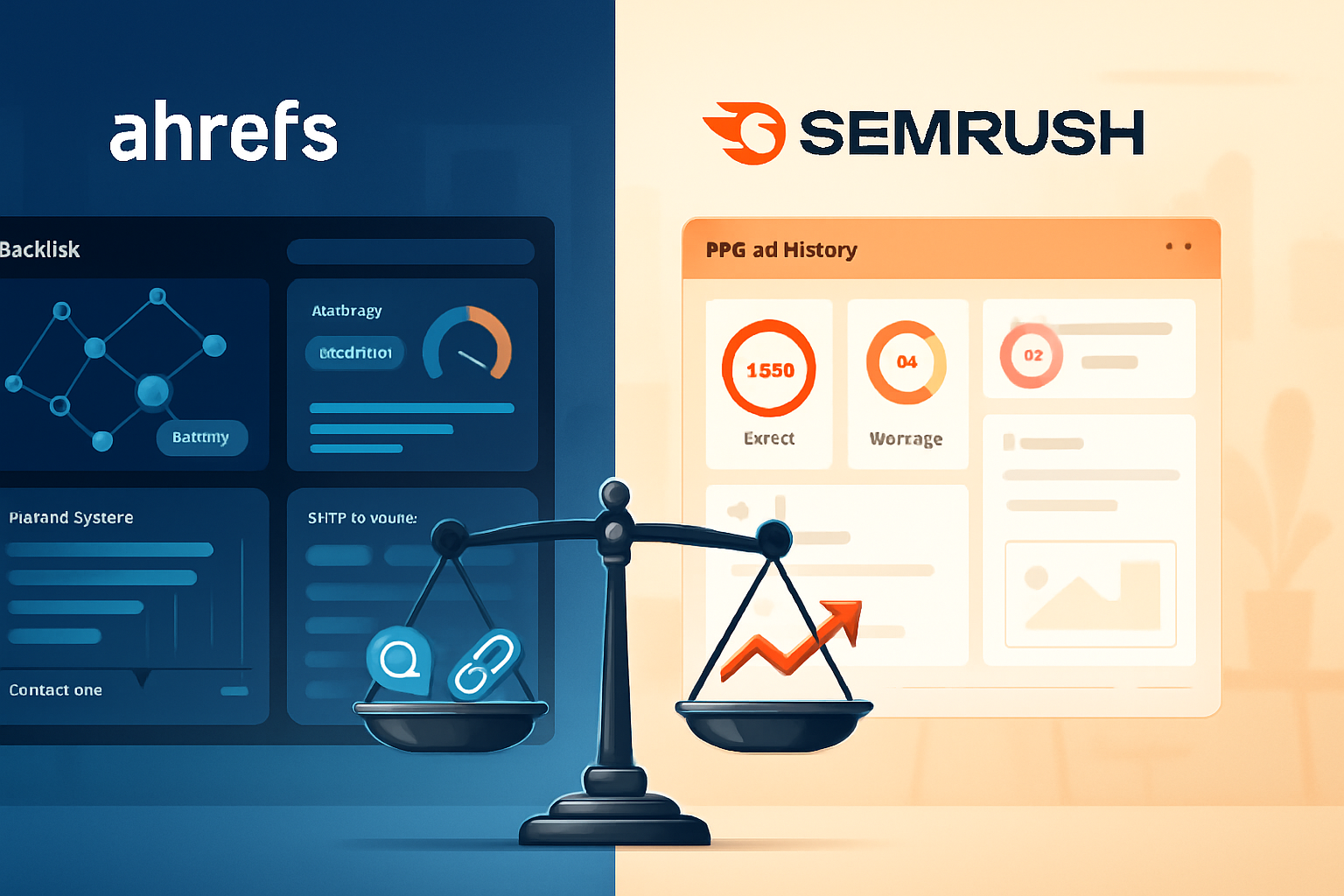
Outcome: pick the right SEO platform for your needs - fast.
By the time you finish this article you’ll know which tool to pick for keyword research, backlink analysis, site audits, PPC support, and team workflows. You’ll also read three real-world case studies (an ecommerce team, an agency, and a solo content marketer) and get a straightforward recommendation based on budget and goals.
Why this matters: choosing the wrong platform wastes time and money. Choose the right one and you accelerate growth.
A quick summary (if you only have 60 seconds)
- Use Ahrefs if your priority is best-in-class backlink data, fast keyword research for organic content, and a clean, fast interface for solo or in-house SEO work.
- Use SEMrush if you need a broader all-in-one marketing suite - especially if you do paid search (PPC), competitive advertising analysis, social media, or need advanced reporting and team features.
- For hybrid teams that need both backlink depth and marketing funnels, consider using both (or choose the one that fits your highest-priority workflows first).
What we’re comparing (scope)
We compare the tools across the most consequential dimensions for marketers in 2023:
- Data accuracy for backlinks and keywords
- Keyword research and content planning
- Site auditing and technical SEO
- Competitive intelligence and market research
- PPC and advertising support
- Reporting, management, and collaboration
- Pricing and value
We’ll also show real-world examples and user experiences so you can see the tools applied, not just theorized.
Ahrefs at a glance
Ahrefs is known for its lightning-fast crawler and deep backlink index. It’s built by SEOs for SEOs, and its interface is focused, efficient, and intentionally lean on non-SEO marketing features.
Key strengths:
- Industry-leading backlink database and link metrics.
- Fast, intuitive keyword explorer and content gap tools.
- Clean UI for exploring organic search and content opportunities.
- Excellent for backlink auditing and link prospecting.
Limitations:
- Less emphasis on paid search, advertising creative intelligence, or social media tools compared to full-stack platforms.
- Reporting and client-dashboard features are more basic than some enterprise suites.
Official resource: https://ahrefs.com (and pricing: https://ahrefs.com/pricing)
SEMrush at a glance
SEMrush positions itself as an all-in-one digital marketing platform. It covers SEO, PPC, content, social, PR, and more - and its feature set is broader than most competitors.
Key strengths:
- Strong competitive analytics for both organic and paid search.
- Advertising research and keyword-value estimation for PPC.
- Built-in content marketing toolkit and social media scheduler.
- Robust reporting templates, white-label options, and collaboration features for agencies.
Limitations:
- Backlink index is solid but historically not as deep as Ahrefs in some use cases.
- The breadth can feel overwhelming if you only want focused backlink and content tools.
Official resource: https://www.semrush.com (and pricing: https://www.semrush.com/pricing/)
Head-to-head: data accuracy (backlinks & keywords)
Backlinks
- Ahrefs has a reputation for one of the largest and most frequently updated backlink indexes. For link research, Ahrefs is often faster at surfacing newly discovered links and broken links.
- SEMrush also maintains a large backlink index and has improved its freshness and coverage in recent years. It tends to excel when you need combined backlink + paid-ad overlap intelligence.
Verdict: If backlink discovery and link profile depth are your #1 priority, Ahrefs usually pulls ahead.
Keywords
- Both tools provide huge keyword databases. Ahrefs’ Keyword Explorer emphasizes click metrics and search intent features; SEMrush couples keyword research with CPC and PPC competition metrics and integrates them into its advertising research.
Verdict: For organic-only keyword research, Ahrefs is fast and intuitive. For combined organic + paid keyword strategy, SEMrush is more convenient.
References: Official product pages from Ahrefs and SEMrush for their tool descriptions: https://ahrefs.com, https://www.semrush.com
Head-to-head: keyword research & content planning
Ahrefs strengths:
- Content Gap / Content Explorer workflows are excellent for finding content ideas and the exact keywords competitors rank for.
- Keyword difficulty metric is transparent and useful for content-first strategies.
SEMrush strengths:
- Topic Research and Content Marketing Platform add editorial planning, briefs, and integration with its SEO Writing Assistant.
- Integrates paid competition (CPC, ad history) directly into keyword lists.
When to pick which
- Choose Ahrefs when you’re a content-driven team that needs fast discovery of content opportunities and backlink prospects.
- Choose SEMrush when editorial teams require briefs, on-page guidance, and integrated tracking of organic + paid performance.
Head-to-head: site audit and technical SEO
Both platforms offer site auditing modules that crawl your site and surface issues like broken links, duplicate content, speed problems, indexing issues, and schema errors.
- Ahrefs Site Audit gives clear actionable items with prioritized issues and a focus on crawlability and internal linking.
- SEMrush Site Audit includes more detailed on-page checklists, JavaScript rendering testing, and better integration with their on-site SEO recommendations and the Content Marketing Platform.
Verdict: For pure technical SEO audits, both are strong. SEMrush provides richer integration with content workflows and tracking; Ahrefs is slick and easier to interpret for link-focused technical fixes.
Head-to-head: competitive intelligence & PPC
This is where SEMrush often pulls ahead.
- SEMrush allows deep ad-copy research, ad-history visibility, and competitor paid keywords and budgets estimates. If you run or consult on PPC campaigns, SEMrush’s advertising tools are hard to beat.
- Ahrefs gives some paid keyword insights but does not offer the same level of ad-creative and historical PPC analysis.
If you manage both organic and paid channels, SEMrush provides more integrated insights that reduce tool-hopping.
Head-to-head: reporting, team features, and agency needs
- SEMrush - strong reporting templates, PDF white-label reports, client management, multi-user permissions, and project-level collaboration tools.
- Ahrefs - improved reporting recently, but still more straightforward reporting with fewer agency-specific templates.
For agencies or teams that need polished client reports and multi-channel dashboards, SEMrush is often the preferred choice.
Pricing & value (2023 snapshot)
- Both platforms use tiered subscription pricing. As of 2023, SEMrush tends to offer more “all-in-one” capabilities at comparable price points, while Ahrefs charges for deeper access to backlink and keyword data on plans geared toward SEOs.
- Consider which modules you’ll actually use. A more expensive SEMrush plan that replaces multiple tools can be better value than a cheaper Ahrefs plan plus third-party reporting tools.
Always review current pricing on the vendor pages before buying: https://ahrefs.com/pricing and https://www.semrush.com/pricing/
Real-world case studies and user experiences
Case study 1 - Ecommerce brand: faster wins with Ahrefs
- Situation - A mid-sized ecommerce site needed to recover organic traffic and discover quick content/inward-link wins.
- Approach - They used Ahrefs’ Site Explorer and Content Gap tools to identify 120 low-difficulty keywords and 250 link prospects (broken pages, unlinked brand mentions).
- Outcome - In 6 months they saw a 38–45% lift in organic sessions for targeted categories and secured several high-value editorial links. Ahrefs’ backlink alerts also helped them react quickly to lost links.
- Why Ahrefs worked - Link discovery speed and straightforward content gap workflows let a small in-house team prioritize high-impact tasks and measure results quickly.
Case study 2 - Digital marketing agency: SEMrush for cross-channel growth
- Situation - An agency managing both SEO and PPC campaigns for a national brand needed unified reporting and ad-competitive intelligence.
- Approach - They used SEMrush to build competitive ad benchmarking, create content briefs for SEO teams, and generate monthly white-label reports for clients.
- Outcome - The agency reduced reporting time by 40%, improved client retention because reports were consolidated and actionable, and lifted combined organic + paid ROI by reallocating budget using SEMrush ad-history insights.
- Why SEMrush worked - Integrated advertising and reporting features reduced tool friction across teams and clients.
Case study 3 - Solo content marketer: mixed use, budget-conscious
- Situation - A solo marketer on a limited budget needed keyword ideas, content briefs, and occasional backlink checks.
- Approach - They started with Ahrefs for keyword and backlink discovery, then experimented with SEMrush’s free tools and trial for content briefs.
- Outcome - Ahrefs was their primary tool for ongoing content planning; SEMrush’s one-off features were useful during campaigns where they needed PPC insights or branded reports for a freelance client.
- Why this pattern is common - Many solo practitioners prioritize Ahrefs’ core SEO features and add SEMrush for wider marketing needs during project peaks.
User experiences - common themes from marketers
- People who love Ahrefs praise its speed, backlink coverage, and intuitive content workflows.
- People who prefer SEMrush value the breadth - the ability to look at paid + organic simultaneously and produce client-ready reports.
- Many teams end up using both, especially agencies that require both deep link data and client reporting/advertising intelligence.
How to choose: a practical decision framework
Define your primary objective
- Backlink-heavy outreach and content-first SEO - lean Ahrefs.
- Cross-channel marketing, PPC, or agency reporting - lean SEMrush.
Map tasks to tools
- Keyword discovery + content ideation - Ahrefs or SEMrush (Ahrefs for organic focus, SEMrush for combined organic+paid).
- Backlink audits & prospecting - Ahrefs.
- PPC research and ad-history - SEMrush.
- Client reporting and team workflows - SEMrush.
Consider budget and consolidation value
- If you’d otherwise buy multiple tools (rank tracker + backlink tool + PPC research tool + reporting tool), SEMrush’s broader suite can be cost-efficient.
- If you need only link depth and content ideation, Ahrefs is often more focused and comfortable to use.
Trial and test
- Use free trials and small-month plans to run a real project (audit your site, test keyword lists, pull backlink reports). Real usage will surface the strengths and weaknesses faster than feature lists.
Quick comparison checklist (copy-paste)
If you need:                Choose:         Why:
Backlink depth              Ahrefs          Bigger/faster link index and link prospecting workflows
Organic-only content SEO    Ahrefs          Faster content gap and keyword discovery
PPC + ad intelligence       SEMrush         Ad-history, CPC estimates, ad-copy research
Client reporting & agency   SEMrush         White-label reports, project management features
All-in-one marketing suite  SEMrush         Saves on multiple subscriptions
Budget, lean solo SEO       Ahrefs          Focused and faster for organic wins
Final verdict - which tool reigns supreme in 2023?
There is no single universal winner. The “supreme” tool depends on the job:
- Ahrefs is supreme for backlink analysis, content gap discovery, and fast organic research. If your mission is organic growth through content and links, Ahrefs is typically the smarter, faster choice.
- SEMrush is supreme for multi-channel marketing, combined organic + paid strategies, agency workflows, and robust reporting. If you manage ad budgets or need client-facing dashboards, SEMrush is often more valuable.
If forced to pick one for most businesses: SEMrush wins on versatility and breadth; Ahrefs wins on core SEO (especially links). Your final decision should follow the workflow that produces the most impact for your team.
Next steps (practical)
- List your top 3 SEO tasks that drive revenue (e.g., recover 20% organic traffic, increase category conversions, reduce PPC waste).
- Run a 14–30 day trial of the tool that maps best to those tasks and execute a small test project (audit + 1 keyword cluster + outreach experiment).
- Measure lift after 60–90 days and decide whether to expand features or add the other tool for missing capabilities.
Helpful resources
- Ahrefs: https://ahrefs.com
- SEMrush: https://www.semrush.com
- Search Engine Journal (general SEO insights): https://www.searchenginejournal.com