· marketing · 7 min read
SEMRush Myths Busted: What You Really Need to Know
A clear, evidence-based debunking of the most common misconceptions about SEMrush - pricing, data accuracy, and the learning curve - plus practical, actionable guidance so marketers can decide with confidence and get value fast.
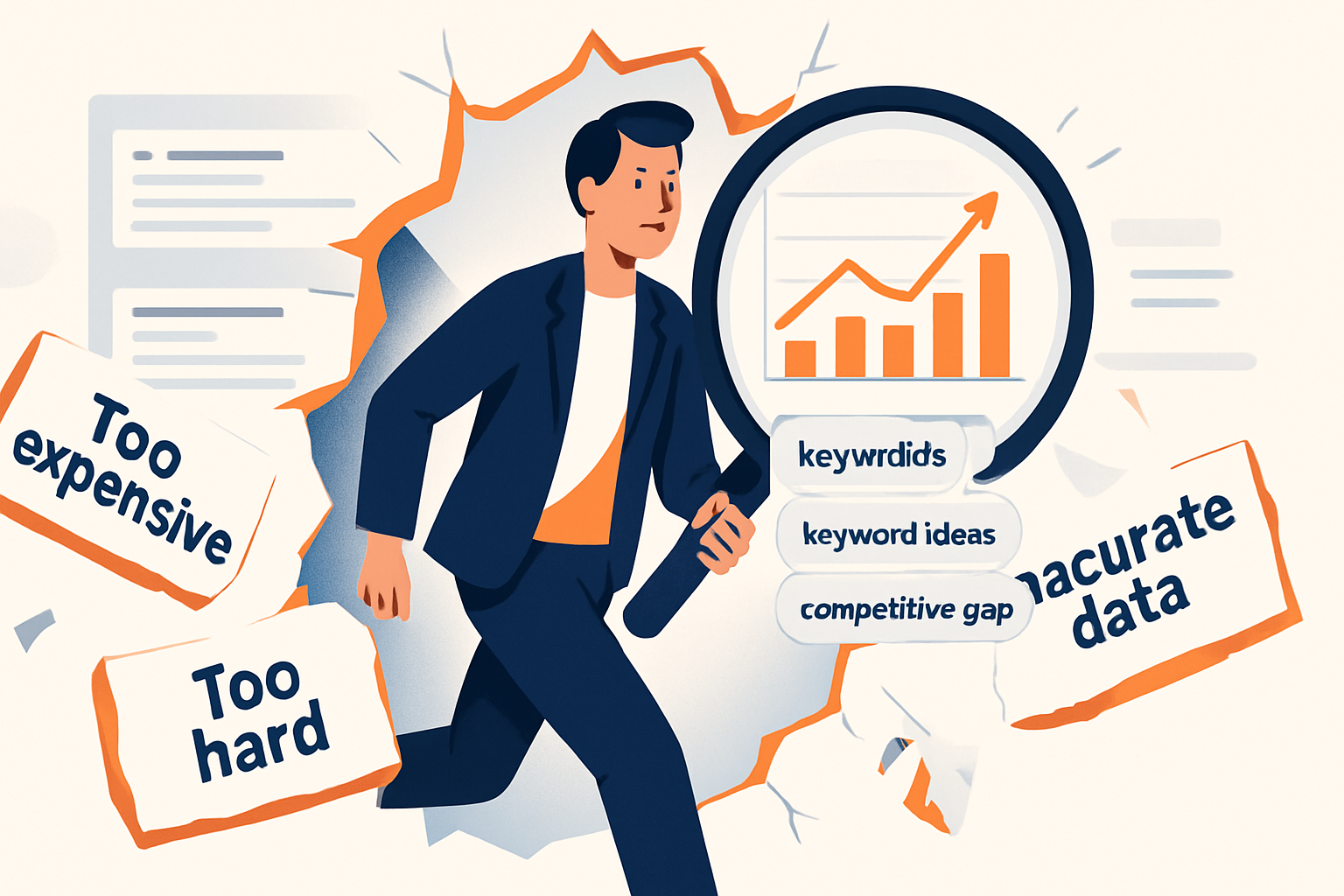
Outcome first: by the time you finish this article you’ll know exactly what realistic value to expect from SEMrush, how to validate its data, and how to get measurable wins in days - not months.
Why this matters: tools cost time and money. Use the right expectations and you get ROI quickly. Misunderstand them and you’ll either overspend or underutilize a powerful platform.
Quick roadmap - what you’ll get from this post
- Clear answers to three common SEMrush myths - pricing, accuracy, and learning curve.
- Practical tests and workflows to validate data for your business.
- A 7-step quick-start checklist to get wins in days.
- A decision checklist to decide if SEMrush is the right fit.
Myth #1 - “SEMrush is too expensive”
Reality: SEMrush is not a single product with a single price. It’s a suite of interlocking features with tiered plans and usage limits. That means the price you pay depends on how you plan to use it - the number of seats, the number of projects, API access, and the add-ons you choose.
Why the myth sticks: people look only at the headline monthly fee and compare it to a single-feature or free tool. They don’t factor in the time saved by having keyword research, site audits, competitive intelligence, content tools, and reporting in one platform.
How to evaluate cost rationally
- Start by listing outcomes you need - audit frequency, competitor research depth, reporting cadence, and whether you need API or multiple seats.
- Map those outcomes to plan limits (projects, reports, keywords). See the current plan matrix on SEMrush’s pricing page: https://www.semrush.com/pricing/.
- Consider usage-based controls - schedule fewer automated audits, restrict seats to power users, and export only needed reports to avoid hitting usage caps.
When SEMrush is cost-effective
- You replace multiple single-purpose subscriptions (rank tracker + keyword tool + backlink tool + reporting) with one suite.
- You need rapid competitive intelligence and trend spotting - a consolidated dataset is faster than cobbling together multiple tools.
When look for alternatives
- You only need a light, single feature (e.g., a one-off keyword list of 50 terms). A cheaper single-purpose tool or free resources may be better.
Myth #2 - “SEMrush data is inaccurate / can’t be trusted”
Reality: SEMrush provides estimates - not literal ground-truth counts - and those estimates are best used for trends, competitive comparisons, opportunity discovery, and prioritization rather than exact traffic or absolute keyword volumes.
Why the myth persists: users sometimes treat SEMrush numbers as a precise substitute for their own analytics. That produces confusion when the tool’s estimates differ from internal metrics.
How SEMrush gets its data (at a high level)
- SEMrush aggregates multiple data sources and models - public SERP data, web scraping of results, and third-party panels/clickstream datasets. Those inputs are then processed and extrapolated into the estimates you see.
- The general principle is the same for other market tools - they all estimate from samples and models. For background on one common input type see clickstream data: https://en.wikipedia.org/wiki/Clickstream.
Practical rules for using SEMrush data correctly
- Use SEMrush for relative comparisons and trends, not daily-accurate traffic accounting. If Keyword A shows 10k search volume and Keyword B shows 2k, treat that as “A is significantly bigger” rather than “A gets exactly 10,000 searches.”
- Cross-check important numbers with your own first-party data (Google Search Console, Google Analytics). If your Search Console shows a different impression or CTR pattern, reconcile and prioritize your first-party signals.
- Validate big decisions. Before rearchitecting a content strategy around a single keyword or competitor, sample-search the SERP, inspect intent, and run a pilot content test for a few weeks.
- Export raw data and double-check top opportunities manually. A quick manual sanity check will save wasted hours.
Resources to help: connect your Google Search Console and Google Analytics to SEMrush to enrich their estimates with your first-party data and make comparisons simpler:
- Google Search Console: https://search.google.com/search-console/about
- Google Analytics: https://analytics.google.com/analytics/web/
Myth #3 - “SEMrush takes months to learn”
Reality: There’s a learning curve, but the path to value is short - weeks, often days - if you focus on one high-impact workflow and avoid trying to learn every feature at once.
Why the myth grows: SEMrush is feature-rich. People try to learn everything at once and get overwhelmed.
A fast, practical onboarding (get value in days)
- Connect Google Search Console and Google Analytics. That gives immediate context and lets you compare SEMrush estimates to your real performance.
- Run a Site Audit for your site. Prioritize the top 5 issues it finds and fix them.
- Set up Position Tracking for your top 20–50 keywords (the ones you actually care about). Track changes, not perfection.
- Pull a competitor domain overview for 2–3 direct competitors. Look for 3 quick wins - keywords they rank for and you don’t, pages getting unexpected traffic, and backlink sources to explore.
- Use the Keyword Magic (or keyword research) tool to expand a focused list of content ideas - 10–15 topics is enough to start.
- Schedule a weekly automated report to your inbox. Automation keeps the tool producing value without adding effort.
- Take one SEMrush Academy course tied to your workflow. The platform has free structured lessons that compress the learning curve: https://www.semrush.com/academy/.
Do this and you’ll have measurable, repeatable output in a small number of hours - not months.
Additional myths worth a quick note
- “SEMrush is only for SEO” - False. It covers paid search, social media analytics, content, and PR workflows. Use the modules you need.
- “SEMrush gives you a one-click guaranteed strategy” - False. It provides insights and signals; humans convert insights into strategy and execution.
- “All tools are interchangeable” - False. Each tool uses different samples and models. Use more than one if you need triangulation for big bets.
Hands-on validation tests you can run in one afternoon
- Cross-check top 10 keyword volumes against Google Search Console impressions. Are the relative rankings similar?
- Export backlinks for a competitor and sample 10 links manually. Are they real and relevant?
- Run a content gap report and verify 3 suggested keywords by checking SERP intent and top-ranking pages.
These quick experiments reveal how SEMrush performs for your niche and use case.
Cost control and getting more bang for your buck
- Pick the smallest plan that satisfies your immediate workflows. Upgrade only when you need higher limits.
- Use shared dashboards and scheduled reports to reduce the need for multiple seats.
- Use Trial / Monthly first if you have an uncertain pipeline, then switch to annual only when the tool proves its ROI.
Refer to the official plan details before buying: https://www.semrush.com/pricing/.
7-step quick-start checklist (copy-paste)
- Create account and connect Google Search Console + Google Analytics.
- Run Site Audit and solve top 5 issues.
- Set up Position Tracking for 20–50 priority keywords.
- Run a Competitor Domain Overview for 2–3 direct competitors.
- Export a 50–100 keyword opportunity list from Keyword Magic.
- Schedule an automated weekly performance report to stakeholders.
- Complete one SEMrush Academy course aligned to your main goal.
Do these seven steps and you’ll have a baseline of actionable insights in a single week.
Decision checklist - should your team buy SEMrush?
- Do you need integrated research across SEO, PPC, content, and competitive intelligence? If yes, SEMrush is a strong candidate.
- Do you have at least one person who will use the platform regularly and act on its insights? Tools only pay off when someone uses them.
- Do you need enterprise-level API access or multi-location tracking? Those features justify higher-tier plans.
- Can you validate the platform with a short pilot (use the checklist above) before committing long-term? If yes, run the pilot.
If you answered yes to two or more of the first three, run the pilot. The pilot will tell you whether SEMrush fits your workflows and budget - quickly.
Final takeaways (short and decisive)
- SEMrush is not overpriced or mysterious - it’s a tiered, powerful suite. Price and value depend on how you use it.
- Its data are estimations - excellent for trend analysis, competitive research, and prioritization, imperfect for exact traffic accounting - always reconcile with first-party data.
- The learning curve is real, but short when you focus on one workflow. A structured 7-step onboarding delivers measurable wins in days.
Treat SEMrush as a signal provider and workflow accelerator. Use experiments and first-party checks to convert those signals into confident decisions. Do that, and the tool will repay its cost many times over.