· marketing · 7 min read
Is Ahrefs Worth the Price? A Comprehensive Cost-Benefit Analysis
A clear, practical analysis of whether Ahrefs' features justify its cost for freelancers, small businesses, in-house teams, agencies, and enterprises - with competitor comparisons, ROI scenarios, and actionable buying guidance.
What you’ll get from this article
You’ll walk away knowing whether Ahrefs will pay for itself in your business - and how fast. Read this and you’ll be able to compare Ahrefs to cheaper and enterprise alternatives, calculate a simple ROI for your situation, and make a buying decision with confidence.
Quick answer (if you want it up front)
Yes - for many businesses Ahrefs is worth the price. But not for everyone. It delivers world-class backlink data, fast keyword research, and content/competitive intelligence that can drive organic growth. The question is whether that growth is large enough (or quick enough) to justify the monthly/annual subscription compared with cheaper toolchains or free alternatives.
Now the nuance.
What Ahrefs actually gives you
Ahrefs is a full-suite SEO platform. The headline modules are:
- Site Explorer - backlink index, organic keywords for any domain, top pages.
- Keywords Explorer - search volume, keyword difficulty, click metrics, SERP analysis.
- Site Audit - crawl your site, find technical SEO issues.
- Rank Tracker - daily or weekly SERP tracking for target keywords.
- Content Explorer - find top-performing content and content gaps.
- Alerts, Batch Analysis, API access, and reporting features.
Those features are tightly integrated, fast, and backed by one of the largest backlink databases in the market. You don’t get a single point product; you get a full toolkit.
Sources and product pages: Ahrefs (pricing & features) - see official site for the current plan details: https://ahrefs.com
Cost overview (how pricing works)
Ahrefs is sold as a subscription with tiered plans that limit users, tracked keywords, campaigns/projects, and API calls. Pricing varies by plan, billing cadence (monthly vs yearly) and occasional promotions. For the definitive numbers check Ahrefs’ pricing page: https://ahrefs.com/pricing
Key cost levers to watch:
- Seats/users - additional users increase cost.
- Tracked keywords and projects - heavy usage pushes you into higher tiers.
- API access and data exports - enterprise needs can be expensive.
Benefits measured as business value
To answer “Is it worth it?” you need to map features to outcomes. Here are the main value channels and why they matter:
Backlink intelligence that drives link-building strategy
- Knowing who links to competitors and why lets you replicate wins.
- High-value backlinks can move rankings and produce sustained organic traffic gains.
High-confidence keyword insight
- Accurate search volumes, SERP features, and click metrics help prioritize pages with real ROI potential.
Content ideation and gap analysis
- Content Explorer surfaces proven topics and angles; that reduces wasted content creation costs.
Faster technical fixes and fewer regressions
- A robust Site Audit prevents revenue-killing errors and improves crawl efficiency.
Time savings and repeatability
- One platform reduces manual scraping, spreadsheet chaos, and the time needed to produce reports.
Each of these maps to revenue (more traffic, higher conversions) or cost reduction (less wasted effort). Put simply: the tool pays when its insights lead to actions that increase net revenue more than the subscription cost.
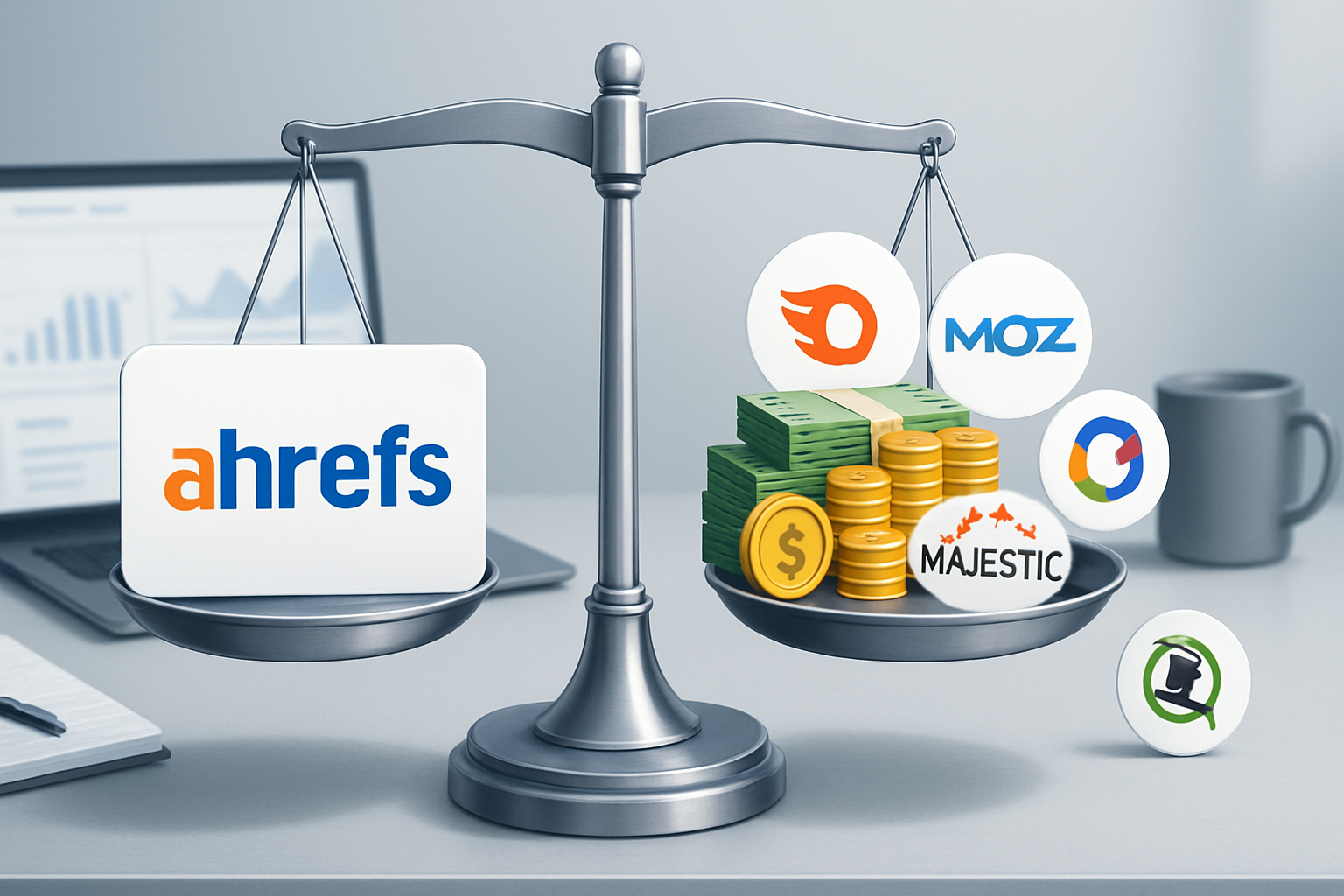
Competitor snapshot - quick comparison
- SEMrush - Comparable all-in-one SEO suite with additional PPC competitive features. Strong rank tracking and advertising intelligence. https://www.semrush.com/pricing/
- Moz Pro - Easier learning curve and good local SEO features; backlink index generally smaller. https://moz.com/products/pro
- Majestic - Focused on backlinks; depth of link metrics but fewer keyword/content features. https://majestic.com/plans
- Ubersuggest (Neil Patel) - Lower-cost keyword tool suitable for freelancers/small teams; less data depth. https://neilpatel.com/ubersuggest/
- Screaming Frog - Desktop crawler for technical audits; one-time fee for a license, pairs well with other tools. https://www.screamingfrog.co.uk/seo-spider/
- Free tools (Google Search Console, Keyword Planner) - Essential and free, but incomplete as a standalone SEO solution. https://search.google.com/search-console/about, https://ads.google.com/home/tools/keyword-planner/
Each competitor has strengths. SEMrush competes on breadth and advertising insights. Majestic excels at historical backlink metrics. Ahrefs generally leads for raw backlink database size, freshness, and usability of exploratory features.
Practical ROI scenarios
Below are simplified examples - use them as templates for your own numbers.
Scenario A - Small e-commerce store (monthly revenue baseline: $25,000)
- Cost of Ahrefs - assume $100–200/month (adjust by current pricing).
- Action - Identify 10 low-competition keywords that could each drive 300 visitors/month. Prioritize and optimize 10 product pages.
- Conversion rate - 2% (industry dependent). Average order value (AOV): $80.
Estimated new monthly revenue: 10 keywords _ 300 visitors _ 2% * $80 = $4,800
Monthly net gain after Ahrefs cost: $4,800 - $150 ≈ $4,650. ROI: very positive. Even if half that traffic materializes, ROI is still strong.
Scenario B - Local service business (monthly revenue baseline: $12,000)
- Cost of Ahrefs - $100–200/mo.
- Action - Use Local keyword research + content and fix technical issues.
- Expected new leads - 4 qualified leads/month. Close rate: 25%. Average contract value: $1,200.
New revenue: 4 _ 25% _ $1,200 = $1,200/month. Net after tool cost: ~$1,050. Still positive.
Scenario C - Freelancer or hobby blog
- Cost of Ahrefs - $100–200/mo may be high if you’re not monetizing well.
- Action alternatives - Combine free tools (Google Search Console) + a low-cost keyword tool like Ubersuggest and Screaming Frog for audits.
Result: For hobby projects or low-revenue freelancing, cheaper alternatives or paying for a short-term trial may be smarter.
Notes on conservatism: These are simplified and optimistic examples. Real results depend on execution, competition, and conversion optimization.
Who should seriously consider Ahrefs?
- Growth-stage startups with measurable LTV (lifetime value) - If you can quantify how many organic visitors equal a new customer over time, Ahrefs helps accelerate that channel.
- SEO-focused agencies - The time savings, reporting, and large data limits make it a practical investment that can be billed out.
- Mid-market e-commerce with many SKUs - Finding traffic opportunities at scale is where Ahrefs shines.
- Competitive industries where backlink intelligence matters - When links move the needle, better data matters.
In short: if your SEO work is a direct lever on revenue or cost-savings and you’ll use the platform weekly, it’s likely worth it.
Who should pause or look for alternatives?
- Hobby bloggers and very early-stage solo founders without clear monetization.
- Businesses that only need basic monitoring and use Google Search Console and occasional manual research.
- Teams with strict budget constraints who can stitch together cheaper tools and manual processes.
For these cases, consider a targeted, lower-cost toolchain: Google Search Console + Google Keyword Planner + Screaming Frog (one-time license) + a low-cost keyword tool such as Ubersuggest. This won’t match Ahrefs’ depth, but it’s functional and economical.
Hidden value and non-monetary benefits
- Competitive advantage - better data often leads to faster, smarter experiments.
- Faster hypothesis validation - you can test and rule out keyword/content ideas quickly.
- Recruitment and reporting - polished exports and dashboards improve stakeholder buy-in.
These are harder to quantify but matter when evaluating strategic decisions.
Practical tips to maximize ROI
- Start with a project plan. Know which pages or keyword clusters you’ll target in the first 90 days.
- Use the platform weekly for at least 3 months - SEO gains compound slowly.
- Leverage Content Explorer to repurpose content and capture low-hanging traffic.
- Combine Ahrefs data with internal metrics (Google Analytics, CRM) to attribute wins.
- Consider annual billing for a discount and manage users/projects to fit a tier.
- If you’re an agency, bake tool cost into retainer fees or offer it as a line item.
Final verdict (short, decisive)
Ahrefs is worth the price when: your SEO work is tied to clear revenue outcomes, you need reliable backlink and keyword intelligence at scale, or you are an agency or mid-market business that benefits from time savings and repeatable workflows. If you’re experimenting, strapped for cash, or only need basic monitoring, cheaper toolchains can get you part of the way there.
Make the decision based on expected incremental revenue (or cost savings) vs. the tool cost. If expected monthly gain from prioritized organic traffic comfortably exceeds the subscription, buy it. If it doesn’t, start lean and upgrade later.
Further reading and tool links
- Ahrefs: https://ahrefs.com
- SEMrush pricing and features: https://www.semrush.com/pricing/
- Moz Pro: https://moz.com/products/pro
- Majestic: https://majestic.com/plans
- Ubersuggest: https://neilpatel.com/ubersuggest/
- Screaming Frog SEO Spider: https://www.screamingfrog.co.uk/seo-spider/
- Google Search Console: https://search.google.com/search-console/about
- Google Keyword Planner: https://ads.google.com/home/tools/keyword-planner/
If you want, I can help you calculate a simple break-even ROI using your actual metrics (current traffic, conversion rate, AOV, and target rank increases).