· marketing · 7 min read
Salesforce Marketing Cloud vs. Competitors: The Ultimate Showdown
A practical, side-by-side analysis of Salesforce Marketing Cloud and its top competitors-strengths, weaknesses, and clear recommendations so marketers can choose the right platform for their goals.
What you’ll get from this article
By the end you will be able to: choose the marketing-cloud platform that matches your business model, anticipate hidden implementation and operating costs, and run a practical vendor evaluation using an actionable checklist. Read fast. Decide smarter. Execute sooner.
Quick verdict (TL;DR)
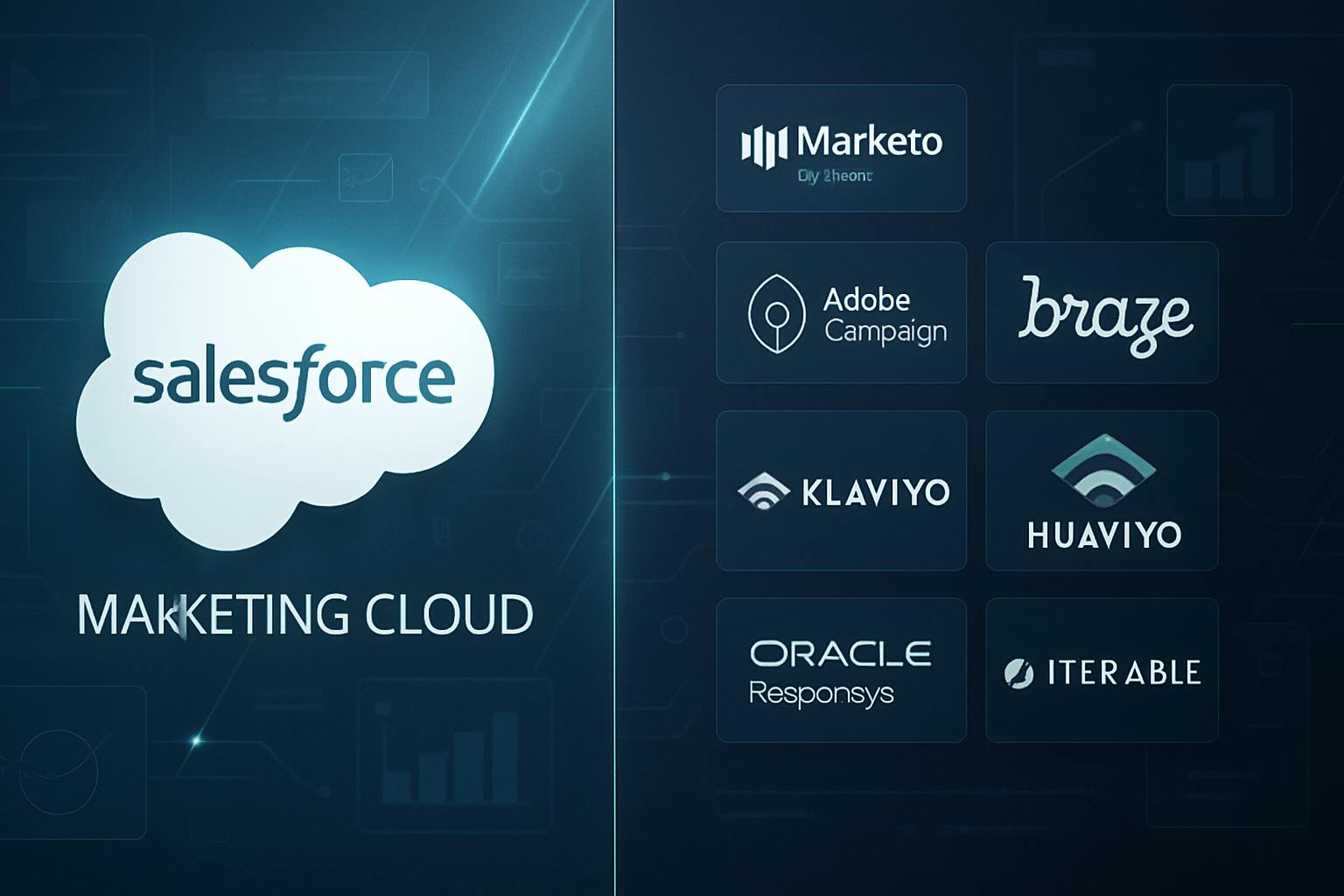
- Salesforce Marketing Cloud (SFMC) - Enterprise-grade, highly extensible and powerful for large, complex businesses. Best where deep CRM alignment, advanced journey orchestration, and a scalable data model matter. Longer implementation and higher cost.
- Adobe (Marketo Engage / Adobe Campaign) - Marketo - excellent for B2B lead management and ABM; Adobe Campaign - strong cross-channel orchestration for enterprise B2C. Great if you need content-driven experiences and analytics tied to Adobe Experience Cloud.
- Braze - Real-time, product/engagement-first messaging for mobile and app-driven businesses. Superb for in-app messaging and behavioral personalization.
- Klaviyo - Best-in-class for ecommerce SMBs and mid-market stores. Fast to set up, rich ecommerce integrations, great ROI for merchants.
- HubSpot - All-in-one platform for mid-market inbound marketing and CRM-driven campaigns. Easiest for teams that want marketing + sales + service in one place.
- Oracle Responsys - Enterprise-level B2C cross-channel with strong campaign automation and robust data-handling; often used by retailers and travel brands.
- Iterable - Flexible for mid-to-enterprise brands seeking cross-channel orchestration with developer-friendly APIs.
Read on for detailed comparisons, pros and cons, real-world trade-offs, and a sharpened checklist to pick the right tool.
Why this comparison matters
Choosing a marketing cloud isn’t an IT checkbox. It changes how you reach customers, measure attribution, and scale personalization. Pick the platform that fits your data model, channel mix, and team skills. Get it wrong and you’ll pay in time, budget, and missed conversions. Get it right and you convert more, faster, with less churn.
Vendor snapshots (concise)
Salesforce Marketing Cloud (SFMC)
- Strengths - Deep CRM integration with Salesforce Sales/Service Clouds, robust journey builder, enterprise scalability, advanced analytics and Einstein AI options, large partner ecosystem. See product details:
- Weaknesses - Complex setup and data model (Contact vs. Subscriber considerations), steep learning curve, higher total cost of ownership, licensing fragmentation across modules (Email Studio, Journey Builder, CDP, Interaction Studio).
- Best for - Large enterprises with complex customer data and teams that need CRM-led marketing.
Adobe (Marketo Engage & Adobe Campaign)
- Strengths - Marketo - excellent B2B lead scoring, engagement programs, and revenue attribution; Adobe Campaign - strong cross-channel orchestration and campaign content management integrated with Adobe Experience Cloud.
- Weaknesses - Multiple Adobe product integration complexity, cost, and sometimes heavy reliance on professional services.
- Best for - B2B companies (Marketo) and large B2C brands needing content- and campaign-driven orchestration (Adobe Campaign).
Braze
- Strengths - Real-time customer engagement, excellent mobile and in-app messaging, strong behavioral segmentation, quick iteration cycles.
- Weaknesses - Can be expensive at scale; not designed as a full CRM replacement.
- Best for - Mobile-first apps, gaming, consumer apps, and product-led businesses.
Klaviyo
- Strengths - Purpose-built for ecommerce, deep Shopify/Magento integrations, easy segmentation, strong ROI for merchants.
- Weaknesses - Not ideal for complex enterprise use cases; limited enterprise-grade features like multi-tenant governance.
- Best for - Ecommerce brands, direct-to-consumer (DTC) retailers.
HubSpot
- Strengths - Unified CRM + marketing + sales + service; easy to use; fast time-to-value.
- Weaknesses - Limits on scaling advanced customization for high-volume, complex enterprise workflows.
- Best for - SMBs and mid-market firms wanting an integrated platform.
Oracle Responsys
- Strengths - Cross-channel campaign management, strong for large retail and travel brands, robust data-handling for complex consumer profiles.
- Weaknesses - Heavy enterprise orientation; implementation takes time.
- Best for - Large B2C organizations with multi-channel needs.
Iterable
- Strengths - Flexible orchestration, modern API-driven platform, good for teams that want control with developer-friendly tools.
- Weaknesses - Fewer out-of-the-box integrations than market incumbents; requires some engineering investment.
- Best for - Teams needing a balance between product-centric messaging and enterprise orchestrations.
Feature-by-feature: how they differ (practical lens)
Below are the features that make or break campaigns, and how the platforms stack.
- Data & Identity (single customer view / CDP)
- SFMC - Offers Salesforce CDP and Data Cloud - strong when your CRM is Salesforce; powerful identity stitching but complex schema. Tight CRM linkage wins for account-based journeys.
- Adobe - Adobe Real-Time CDP integrates across Adobe Experience Cloud - great for content and personalization workflows.
- Braze/Iterable/Klaviyo - Provide event- and profile-based systems; Klaviyo is tuned for ecommerce data. Braze excels at real-time behavioral events.
- HubSpot - Simpler CRM-focused profile model; excellent for sales-marketing alignment but less flexible for complex identity stitching.
- Journey orchestration and real-time capabilities
- SFMC Journey Builder - Powerful, visual, enterprise-scale orchestration. Good for long-running, multi-step programs. Real-time capabilities vary by product modules.
- Braze - Built for real-time triggers; great for session-based and in-app flows.
- Adobe Campaign & Iterable - Strong orchestration; Adobe shines when combined with Experience Cloud for personalization.
- Personalization & AI
- SFMC - Einstein provides predictive scoring, content selection, and send-time optimization. Effective when trained on rich Salesforce data.
- Adobe - Deep content personalization via Adobe Target and Experience Cloud.
- Braze/Klaviyo - Behavioral personalization with fast iteration; Klaviyo’s ecommerce-focused predictive insights are practical and ROI-focused.
- Email deliverability & sending infrastructure
- Enterprise providers (SFMC, Adobe, Oracle) offer robust sending infrastructure and deliverability teams. But deliverability still depends on list hygiene, domain setup, and IP warming.
- Klaviyo and Braze generally have strong deliverability for their use cases but require proper setup at scale.
- Analytics & attribution
- SFMC + Tableau or Salesforce Analytics - Powerful but requires configuration.
- Adobe - Strong marketing analytics, especially when paired with Adobe Analytics.
- HubSpot - Easier, integrated reporting with CRM-centric attribution.
- Integrations & ecosystem
- SFMC - Large AppExchange and partner ecosystem; native Salesforce integrations are a big plus.
- Adobe - Best if you already use Adobe Experience Cloud.
- Klaviyo - Plug-and-play for ecommerce platforms.
- Braze & Iterable - Strong APIs for custom integrations; developer resources required.
- Pricing & TCO
- SFMC & Adobe - Higher licensing and implementation costs; expect multi-month implementations with professional services for complex use cases.
- Klaviyo & HubSpot - Lower entry costs; pricing can ramp with contacts/volume.
- Braze/Iterable - Mid-to-high tier depending on message volume and feature needs.
Real-world trade-offs (you’ll face these)
- Speed vs. Power - Klaviyo and HubSpot = fast time-to-value. SFMC/Adobe = more power, more time.
- Ownership vs. Managed Service - Salesforce and Adobe can be configured as a managed product but usually require pricey professional services. Braze and Klaviyo are more SaaS-first.
- Data Model Complexity - SFMC’s data extension architecture is powerful but can be bewildering. Poor modeling here leads to broken journeys and poor personalization.
- Vendor Lock-in - Deep integrations with Salesforce or Adobe increase switching costs. Plan for exportable data pipelines.
Decision guide: pick based on business profile
- You’re a large enterprise with complex CRM, accounts, and long lifecycle programs - Salesforce Marketing Cloud.
- You’re a B2B organization focused on lead scoring and ABM - Marketo Engage.
- You’re a mobile-first product or app with heavy behavioral triggers - Braze.
- You run ecommerce (Shopify/Magento) and want fast ROI - Klaviyo.
- You want an all-in-one CRM/marketing solution for growth-stage or mid-market - HubSpot.
- You’re a global retailer or travel brand with complex cross-channel needs - Oracle Responsys or Adobe Campaign.
- You need an API-first orchestration layer that devs can extend - Iterable.
Migration checklist (if you’re moving off a platform)
- Inventory everything - audiences, journeys, triggered messages, suppression lists, deliverability domains, tracking setups.
- Map data model - fields, events, identity keys. Keep canonical keys consistent (email + customer_id). Export schemas.
- Rebuild critical journeys first - welcome, cart abandonment, win-back.
- IP & deliverability plan - warm new sending IPs or use shared pools carefully; mirror authentication (SPF, DKIM, BIMI where needed).
- QA & sampling - test content rendering, link tracking, suppression behavior.
- Reporting parity - ensure you can reproduce key KPIs in the new platform before cutover.
- Phased cutover - run dual sends for a short period to compare engagement and deliverability.
Practical scoring matrix (quick evaluation rubric)
Score each criterion 1–5 (5 = excellent for your needs):
- Data & CDP capabilities
- Journey orchestration
- Channel coverage (email, SMS, push, in-app)
- Personalization / AI
- Time-to-value
- Integrations & ecosystem
- Deliverability & sending controls
- Total cost of ownership
Weight the criteria by your priorities (e.g., Data = 30%, Time-to-value = 15%), compute a weighted score, and compare vendors.
Hidden costs and gotchas (learn from others’ mistakes)
- Module bloat - Platforms often sell core and add-on modules; costs multiply. Map necessary features before committing.
- Data egress and API limits - Heavy event-driven systems (Braze, Iterable) can incur higher integration costs.
- Professional services - Enterprise implementations usually need vendor or systems integrator help.
- Deliverability ramp - New platforms need time to build sending reputation. Plan for a warm-up sequence.
- Cross-team operations - Marketing, analytics, legal, and engineering must align on identity and tagging.
Final recommendation: how I’d pick (simple process)
- Define the single most important outcome (e.g., increase revenue per recipient, shorten time-to-lead-conversion, reduce churn).
- Weight evaluation criteria against that outcome.
- Run a 4–6 week pilot with sample audiences and 3 critical journeys.
- Measure - deliverability, engagement lift, engineering effort, and cost per incremental conversion.
- Choose the vendor that delivers the best net business impact, not the flashiest features.
Make decisions with metrics, not opinions. Test before you fully commit.
Resources and further reading
- Salesforce Marketing Cloud: https://www.salesforce.com/products/marketing-cloud/overview/
- Adobe Marketo Engage: https://www.adobe.com/marketing/marketo.html
- Adobe Campaign: https://www.adobe.com/marketing/adobe-campaign.html
- Braze: https://www.braze.com
- Klaviyo: https://www.klaviyo.com
- HubSpot: https://www.hubspot.com
- Oracle Responsys: https://www.oracle.com/cx/marketing/responsys/
- Iterable: https://iterable.com
Make the platform choice an experiment. Start small, measure hard, and scale what actually moves your KPIs. The right marketing cloud amplifies your strategy. Pick accordingly.