· marketing · 7 min read
The Dark Side of Email Marketing: Klaviyo Best Practices to Avoid Pitfalls
A sharp, practical guide to stop common Klaviyo mistakes-over‑segmentation, broken automations, frequency abuse and deliverability errors-and fix them for stronger engagement and revenue.
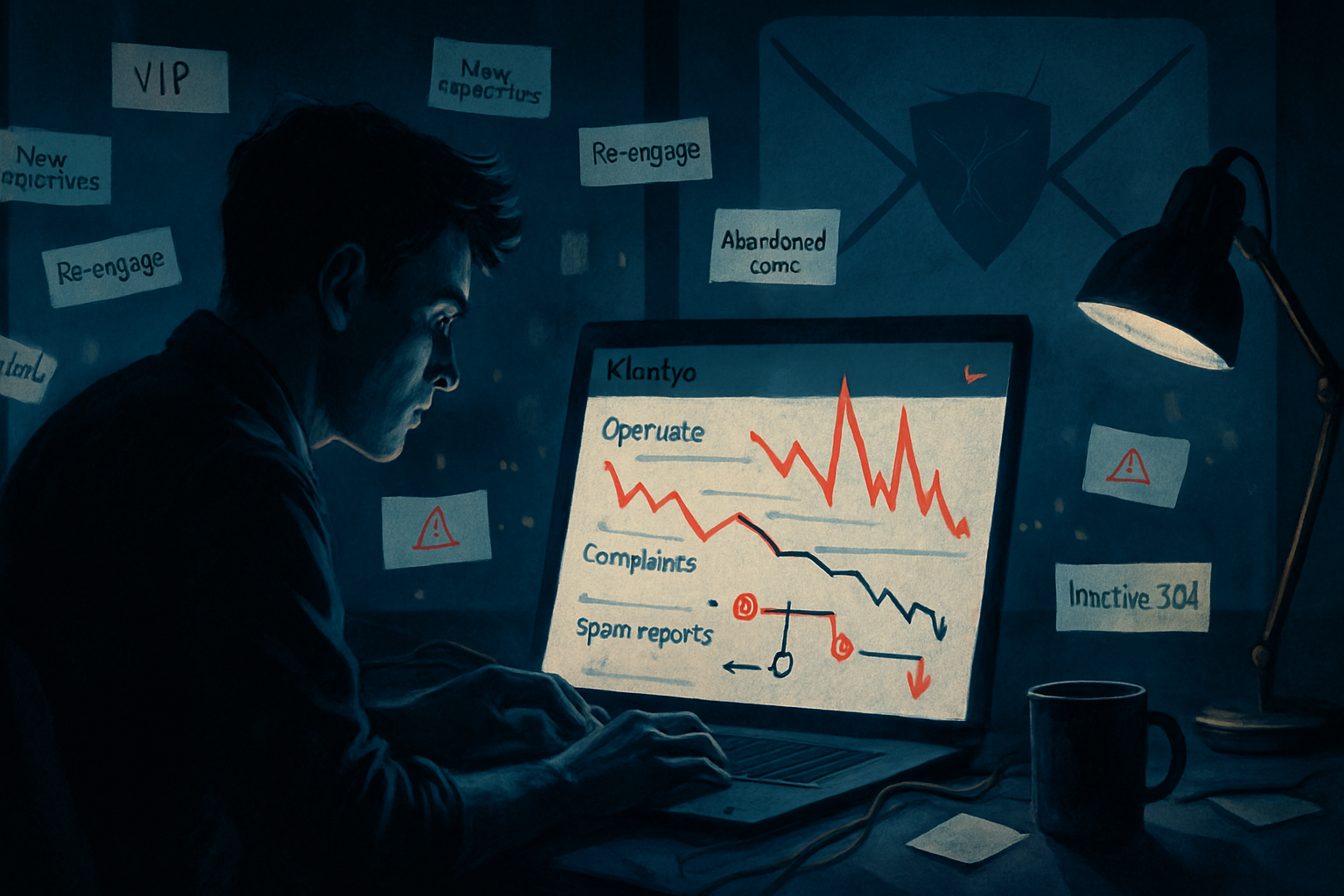
Outcome: Stop burning your list and turn Klaviyo from a chaotic inbox machine into a revenue engine. Read this and you’ll know exactly which Klaviyo sins are costing you opens, clicks and customers - and how to fix them, fast.
Why this matters - and why most guides sugarcoat it
Email isn’t just a channel. It’s the primary revenue engine for many e‑commerce brands. When it’s done right, it scales predictably. When it’s done wrong, you quietly erode deliverability, confuse customers, and waste ad spend on reacquisition. Short term gains look great. Long term they kill your list and your brand. Be blunt: more segments, more flows, more campaigns - without discipline - will wreck performance.
The usual suspects: where teams go wrong with Klaviyo
Below are the recurring mistakes I see in every audit. Each one sounds reasonable until you measure the fallout.
1) Over‑segmentation: personalization or paralysis?
Why teams do it: Personalization feels modern. So they create dozens - then hundreds - of tiny segments for every behavior and micro‑preference. Why it fails: Segments become too small to learn from. Campaigns are duplicated across overlapping groups. You send contradictory messages to the same person from different teams. Results: low statistical power, increased sends per user, and inconsistent CX. Quick signs you’re guilty:
- You have 50+ campaign segments but most contain <500 profiles.
- You run identical campaigns across 10 slightly different segments.
How to repair:
- Create a segmentation hierarchy - Macro segments (e.g., New, Active, At‑risk, Churned) first; micro segments only for high‑value behaviors (repeat buyers, VIPs).
- Use dynamic, behavioral properties rather than static one‑off lists.
- Rule of thumb - reserve micro segments for flows and personalization; keep campaign segments large enough to be statistically meaningful (start thinking in thousands if your revenue depends on campaign testing).
- Use suppression and mutually exclusive segment logic to avoid duplicate sends.
Example segment logic (pseudocode):
Active Customers:
  - Placed Order in last 180 days
  - AND (Email Opened in last 90 days OR Clicked in last 90 days)

At-Risk Customers:
  - Placed Order between 181 and 365 days ago
  - AND Total Spend > $X
Documentation: Klaviyo’s segmentation overview is a good reference for cleaner segment design: https://help.klaviyo.com/hc/en-us/articles/115005082927-Segmentation-overview
2) Poor automation design: flows that don’t think
Common mistakes: generic flows that ignore user context, flows that never end, or branching logic that sends irrelevant messages. Why this matters: Flows are your relationship builders. If they’re wrong, you damage trust at scale.
Fixes that actually work:
- Map the customer journey first. Draw it on a whiteboard. Identify the trigger, the purpose, and the desired next action for every flow.
- Use conditional splits and smart delays. Example - if a user opens but doesn’t click, send a different follow up than someone who never opened.
- Add flow filters and suppression-so purchases, returns, or unsubscribes remove profiles from active flows.
- Audit and retire dead flows. If a flow has conversion < X% or hasn’t been edited in 12 months, it probably needs a rethink.
Example high‑level flow structure:
- Welcome Flow - Email 1 (intro) → Delay 2 days → Email 2 (social proof) → Delay 4 days → Email 3 (promo for first purchase), with conditional split on ‘Placed Order’.
Klaviyo Flows docs: https://help.klaviyo.com/hc/en-us/sections/360005197733-Flows
3) Frequency and fatigue - more sends ≠ more money
The myth: If one email makes money, two makes double. Reality: frequency increases short‑term revenue but raises complaints, unsubscribes and deliverability risk.
How to police frequency:
- Implement a global send cap (e.g., no more than X brand emails per week). Use Klaviyo’s smart sending and suppressions to enforce it.
- Exclude recent purchasers from promotional blasts for a set period (e.g., 30 days).
- Use engagement recency windows - treat someone who hasn’t opened in 6 months differently.
Metrics to watch: open rate trend, unsubscribe rate, spam complaints, inbox placement. If opens decline but sends increase, you’re burning the list.
4) Bad data & tracking - garbage in, garbage out
Symptoms: wrong segments, incorrect revenue attribution, flows firing for the wrong users.
Checklist to fix data:
- Standardize event names and properties (purchase, checkout_started, viewed_product) across platforms.
- Send server‑side events for purchases whenever possible; client JS can drop data when browsers block scripts.
- Deduplicate profile properties and set sensible fallbacks for missing values.
- Time zone and currency normalization - for international lists, sending at local times matters.
Why this is non‑negotiable: A single misplaced event (e.g., a failing purchase webhook) can trigger “order follow‑ups” to everyone who clicked the add‑to‑cart button for months.
5) Personalization gone wrong - tokens, broken fallbacks and creepy targeting
Personalization increases relevance when it works. But template tokens that fail or overly aggressive one‑to‑one content make your brand look amateurish or intrusive.
Best practices:
- Always provide fallback values for personalization tokens (e.g., {{ first_name | fallback - “friend” }}).
- Limit hyper‑personalization to what you can justify publicly. Using a customer’s exact browse history in subject lines can look creepy.
- QA templates across 10+ profiles before enabling a campaign.
6) Deliverability sins - authentication, domain hygiene and IP warming
Even flawless segmentation and flows are wasted if emails never reach the inbox.
Essentials checklist:
- Authenticate your sending domain (SPF, DKIM). Use a branded sending domain, not a generic klaviyo subdomain.
- Warm up new domains and IPs gradually. Sudden 100k sends from a new domain = spam traps.
- Clean lists regularly. Remove hard bounces and high‑complaint addresses.
- Monitor deliverability metrics and reputation.
A primer on deliverability: SparkPost’s guide explains the mechanics and risks well: https://www.sparkpost.com/blog/what-is-email-deliverability/
Measurement: what to track and how to interpret it
Track these KPIs every week and watch for trends, not single data points:
- Open rate (but weight it with engagement changes - opens are unreliable alone)
- Click‑through rate
- Conversion rate (purchases or desired action)
- Unsubscribe rate and complaint rate
- Revenue per recipient (RPR)
A/B testing notes:
- Test one variable at a time.
- Use statistically sound sample sizes. Small segments often can’t support meaningful tests - be honest about power.
Quick audit playbook - 90 minutes to find the rot
- List active segments and sort by size. Flag segments <500. 10 minutes.
- List active flows and last edit date. Flag flows with >12 months no edits or <0.5% conversion. 15 minutes.
- Check top 10 sending campaigns for overlapping audiences and duplicate messaging. 20 minutes.
- Verify SPF/DKIM on sending domains and look for new domain/IPs needing warm‑up. 10 minutes.
- Inspect top funnel event instrumentation for missing purchases or checkout_started events. 20 minutes.
- Pull metrics - open rate trend, unsubscribe/complaint spikes, RPR. 15 minutes.
You’ll have a prioritized list of what to fix first.
The controversial final word: segmenting ≠ strategy
Here’s the truth: segmentation is a tactic, not a strategy. Brands that equate creating new segments with being strategic are just busy. Real strategy ties segmentation and automation to measurable customer value. It asks, for each flow and segment: what business outcome does this drive? If you can’t answer it in one sentence, kill it or redesign it.
Fix the fundamentals - clean data, clear lifecycle flows, sane frequency caps, authenticated domains - and you’ll get far more lift than by creating incremental micro‑segments and complicated branching that no one understands.
Action checklist (do these in order)
- Audit and consolidate segments (start with the macro list).
- Map and simplify flows; add conditional splits and suppressions.
- Implement a global send cap and recent‑purchase suppression.
- Verify tracking events and standardize schema.
- Authenticate domains and review IP warm‑up.
- Setup weekly KPI dashboard for opens, clicks, RPR, unsubscribes and complaints.
Fix these things. Then iterate.
References
- Klaviyo - Segmentation overview -
- Klaviyo - Flows documentation -
- SparkPost - What is Email Deliverability? -
If you implement just three changes from this post - consolidate segments, fix your top 3 flows, and authenticate your domain - your inbox metrics and revenue will improve within weeks. Start there. Move fast. Be ruthless.