· business · 7 min read
How to Avoid Common Klaviyo Mistakes That Are Costing You Money
A practical guide to the most common Klaviyo mistakes-broken tracking, poor segmentation, deliverability slipups, flow misconfigurations-and step-by-step fixes that increase opens, conversions, and ROI.

Outcome first: fix the following Klaviyo mistakes and you’ll send fewer wasted emails, recover more abandoned carts, lift conversion rates, and protect deliverability-so your marketing actually makes money instead of losing it.
Start here. Send smarter. Earn more.
Why this matters (fast)
Every misplaced event, broken flow, or unverified sending domain equals lost revenue. Not immediately obvious? Fine. But the numbers add up quickly: abandoned carts that never get recovered, welcome sequences that don’t convert, campaigns that land in spam.
This post shows you the precise mistakes most stores make in Klaviyo, why each one costs you money, and exactly how to fix it-step-by-step, with practical examples and checklists you can action today.
Top Klaviyo mistakes and how they cost you money
- Poor tracking and missing events
- The mistake - Not installing Klaviyo’s web tracking, not firing purchase or added-to-cart events, or sending duplicate/incorrect events.
- The cost - Flows (abandoned cart, post-purchase, browse abandonment) don’t trigger or send wrong content. Your segments are inaccurate. Attribution and ROI are incorrect.
- Fix - Verify tracking and events
- Install the Klaviyo web tracking snippet or the Klaviyo plugin for your platform (Shopify, Magento, BigCommerce). See Klaviyo’s integration docs: https://help.klaviyo.com/hc/en-us.
- Confirm key metrics arrive - Viewed Product, Added to Cart, Started Checkout, Placed Order. Use the Metrics tab to watch events in real time.
- Eliminate duplicate events-ensure only one integration or pixel is firing. Use browser dev tools to inspect network calls.
- Broken or incomplete flows
- The mistake - Flows are incomplete, untested, or contain hard-coded content that doesn’t personalize for the event. Example: abandoned cart flow that triggers on any cart but sends a generic email without items listed.
- The cost - Low conversion rates from flows; lost recoverable revenue.
- Fix - Audit and optimize flows
- Run a flow audit - check triggers, filters, conditional splits, email timing, and backfills.
- Test dynamic content blocks (e.g., Cart Items block). Use Klaviyo’s preview and live tests by sending to a test profile that has sample events.
- Recommended flow timing - Abandoned cart (15 min, 24 hr, 72 hr with increasing incentives), Welcome series (Day 0, Day 2–3, Day 7), Post-purchase (Order confirmation, Shipping update, Review request at 7–14 days).
- Poor segmentation and overbroad sends
- The mistake - Sending campaigns to entire lists without segmentation or engagement-based targets.
- The cost - Lower open rates, higher unsubscribes, worse deliverability, wasted sends to uninterested recipients.
- Fix - Segment by behavior and recency
- Use segments like:
- Engaged in last 90 days - what_to_send = active_engagers
- High value customers - has_placed_order_at_least(N) and lifetime_value > X
- At-risk customers - last_order > 120 days and total_spent > Y
- Use Klaviyo’s built-in predictive analytics (predicted LTV, churn risk) to prioritize budgets.
- Use segments like:
- Ignoring deliverability and domain setup
- The mistake - Not authenticating sending domain (SPF, DKIM), not warming IP, using default shared domains.
- The cost - Emails land in spam or are blocked; campaign results plummet.
- Fix - Authenticate and monitor deliverability
- Add DNS records for DKIM/SPF as instructed by Klaviyo: https://help.klaviyo.com/hc/en-us/articles/115005078927-How-to-Add-DNS-Records-for-Domain-Verification-and-Email-Authentication
- Use a consistent ‘From’ name and email. Avoid frequent ‘From’ changes.
- Monitor bounce and spam complaint metrics. Implement engagement-based suppression and sunset inactive users (e.g., suppress users not engaged in 12 months).
- No list hygiene or re-engagement policy
- The mistake - Hoarding lists indefinitely, not removing hard bounces, or never sunsetting inactive subscribers.
- The cost - Reduced sender reputation and deliverability; wasted campaign budget.
- Fix - Establish a cleanup cadence
- Immediately - remove hard bounces and invalid emails.
- Quarterly - run a re-engagement flow for users inactive 6–12 months. If they don’t re-engage, unsubscribe them.
- Use suppression lists for known bad/unsubscribed emails.
- Underutilizing A/B testing and failing to iterate
- The mistake - Sending email after email without testing subject lines, send times, or content.
- The cost - Continued low performance. Missed opportunities to improve opens, clicks, and revenue.
- Fix - Make A/B testing routine
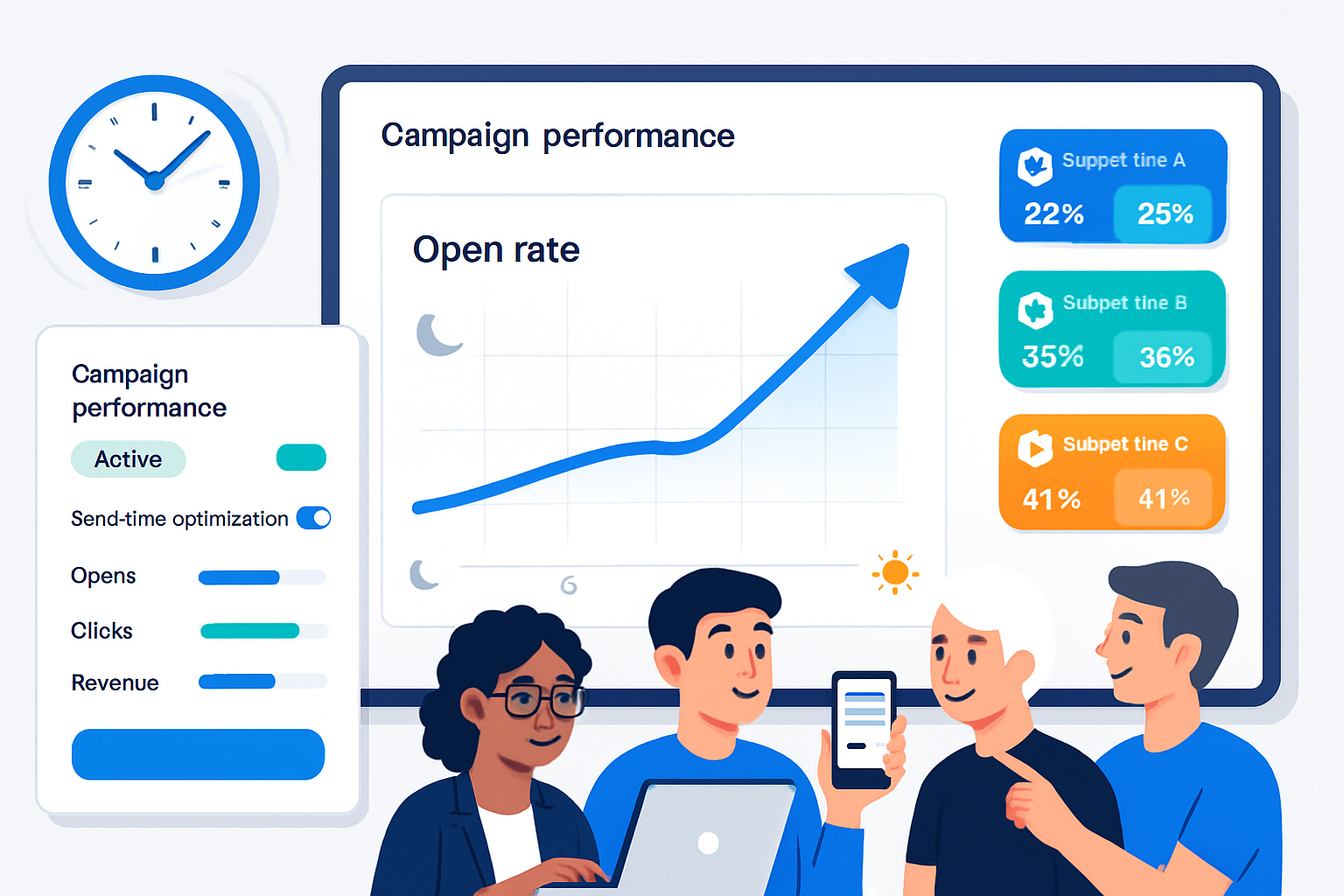
- Test one variable at a time - subject line, preheader, CTA, or send time.
- Run 2–3 variant tests per quarter for top-performing campaigns/flows.
- Use Klaviyo’s built-in A/B testing for campaigns and holdouts for flows where applicable.
- Templates that aren’t mobile-optimized or accessible
- The mistake - Using desktop-first templates with tiny buttons and images that don’t scale.
- The cost - Poor mobile conversion and higher unsubscribes.
- Fix - Build responsive templates
- Use Klaviyo’s responsive blocks. Preview in mobile and multiple clients.
- Keep CTAs large and near the top. Limit images and use alt text.
- Bad UTM and attribution setup
- The mistake - Missing or inconsistent UTM tags, which breaks Google Analytics reporting and ROI calculations.
- The cost - You don’t know which campaigns or flows drive revenue; you can’t optimize effectively.
- Fix - Standardize UTMs
- Use consistent UTM parameters for campaigns and flows - utm_source=klaviyo, utm_medium=email, utm_campaign={{ campaign_name }}.
- Map Klaviyo flows to clear campaign naming conventions so revenue is traceable.
- Non-compliant SMS usage
- The mistake - Sending SMS without proper consent or over-messaging subscribers.
- The cost - Fines, complaints, and unsubscribes.
- Fix - Follow compliance and pacing
- Ensure opt-in documentation and consent. Keep message frequency sensible (segment heavy SMS users). Provide clear opt-out instructions.
- Use Klaviyo’s SMS consent fields and templates responsibly.
- Not using Klaviyo analytics or measuring the right KPIs
- The mistake - Looking only at opens and clicks and ignoring revenue-per-email, flow conversion rates, and LTV.
- The cost - You optimize the wrong thing and miss revenue trends.
- Fix - Track business-focused KPIs
- KPIs to monitor - revenue per recipient (RPR), flow conversion rate, average order value (AOV) from email, LTV, unsubscribe rate, spam complaints.
- Build a dashboard in Klaviyo or BI tool to monitor these weekly.
Practical checklist to fix problems today
- Technical / quick wins
- Verify and authenticate your sending domain (DKIM/SPF) - follow Klaviyo guide: https://help.klaviyo.com/hc/en-us/articles/115005078927-How-to-Add-DNS-Records-for-Domain-Verification-and-Email-Authentication
- Confirm web tracking and purchase events are firing.
- Remove duplicate pixels/integrations.
- Flows and campaigns
- Run a flow audit - test welcome, abandoned cart, post-purchase, and winback flows.
- Ensure dynamic product blocks display correctly in abandoned cart and browse emails.
- Add UTM parameters for all campaigns.
- Segmentation and list hygiene
- Create engagement-based segments and suppress unengaged users.
- Execute a re-engagement flow. Unsubscribe non-responders.
- Remove hard bounces and invalid emails.
- Deliverability and sender reputation
- Warm dedicated IP if you have high volume.
- Keep complaint rate < 0.3%. Remove frequent complainers.
- Segment sends to prioritize engaged recipients.
- Measurement and iteration
- Set revenue-focused KPIs and report weekly.
- Run at least one A/B test per month on high-volume emails.
Flow and segmentation examples (practical)
Abandoned cart flow (3 emails):
- Trigger - Added to Cart but no Placed Order
- Email 1 - 15 minutes - show cart items, bold CTA
- Email 2 - 24 hours - social proof, urgency
- Email 3 - 72 hours - discount or product alternatives
Welcome series (3 emails):
- Email 1 - immediate - brand intro + bestsellers
- Email 2 - 48 hours - education + benefit-driven content
- Email 3 - 7 days - offer or social proof
VIP segment - Customers with lifetime_value > X and placed_order_at_least(3)
- Action - Send exclusive product drops or early access and higher budget ads retargeting.
Segment snippet (example logic):
Segment: Engaged Last 90 Days
Condition: What someone has done (or not done) > Placed Order at least once in the last 90 days OR Opened/Clicked an email in the last 90 days
A/B test ideas that move the needle
- Subject line - short vs curiosity vs clarity.
- Preheader - value-driven vs urgent.
- CTA copy - “Buy now” vs “Get 20% off” vs “View your cart”.
- Send time - morning vs evening for segments.
- Offer vs no-offer in the final abandoned cart email.
Measure lifts in open rate, click rate, and most importantly revenue per recipient.
When to call for help (and what to ask for)
If you’ve checked tracking, DKIM/SPF, and flow logic and still see poor results, escalate with a clear brief:
- Provide test accounts, sample user profiles, and screenshots of Metrics.
- Share your top 3 flows and list of high-volume campaigns.
- Ask for a deliverability audit and a flows/content audit.
Final checklist (copy this into your project board)
- Domain authenticated (DKIM/SPF)
- Web tracking and purchase events verified
- Abandoned cart flow tested and showing cart items
- Welcome, post-purchase, and winback flows live with proper timing
- Engagement-based segments and suppressions in place
- Hard bounces removed and re-engagement cadence scheduled
- UTMs standardized across campaigns
- A/B testing plan and KPI dashboard implemented
- SMS consent and pacing audited (if using SMS)
Fixing these mistakes won’t require a full rebuild. Mostly, it’s a disciplined audit and a few technical fixes. Do that, and you’ll see better deliverability, higher flow revenue, and a much clearer ROI on your Klaviyo investment. Keep your data clean. Automate the right flows. And protect your sending reputation-because nothing converts if your emails never arrive.