· creativity · 6 min read
The Ultimate Writesonic vs. Competitors: A Comparative Analysis
Compare Writesonic to top AI writing tools-Jasper, Copy.ai, Rytr, Copysmith, ChatGPT, and Grammarly-to understand strengths, weaknesses, unique features, and which tool suits your workflow and goals.
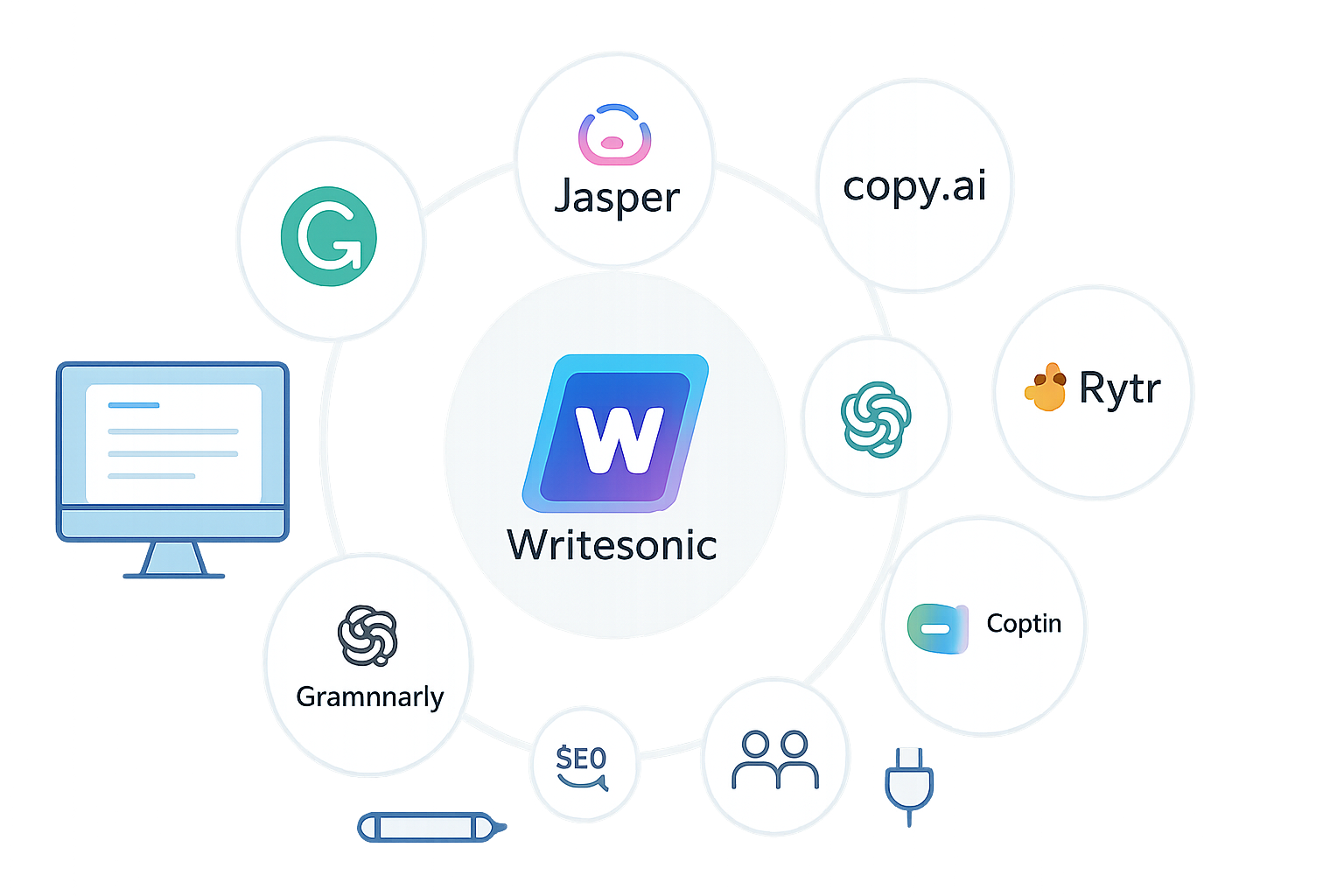
Outcome first: by the end of this article you’ll know which AI writing tool to pick for your use case - whether you need lightning-fast ad copy, long-form SEO articles, polished editing, or an affordable assistant for everyday content. Read on to find the shortest path from “too many tools” to “the right tool.”
Quick verdict up front
- Writesonic is a versatile, user-friendly option that balances templates, long-form capabilities, and affordability. Great for marketers and small teams who need fast outputs and multiple content formats.
- Jasper (formerly Jarvis) is better for teams that want advanced long-form workflows, brand voice control, and a mature content studio.
- Copy.ai and Rytr excel at instant short-form copy - fast, cheap, and easy - but are less robust for long-form or heavy SEO workflows.
- Copysmith targets e-commerce and teams needing collaboration and API scale.
- ChatGPT (OpenAI) offers the most flexible creative and conversational AI but needs shaping for consistent brand outputs and lacks built-in templates/SEO workflows.
- Grammarly is an editor rather than a content generator - the best second layer for quality, tone, and correctness.
If you want a one-stop, affordable marketing assistant, start with Writesonic. If you need enterprise-level long-form content workflows and brand control, look at Jasper or OpenAI-based custom stacks.
How I compared them (so you can trust the results)
I compared tools across these dimensions: output quality, long-form capability, short-form speed, SEO features, templates and workflows, integrations, customization and brand voice control, pricing/value, and teamwork & compliance features. For primary references see the official sites: Writesonic, Jasper, Copy.ai, Rytr, Copysmith, Grammarly, and OpenAI Writesonic, Jasper, Copy.ai, Rytr, Copysmith, Grammarly, OpenAI (ChatGPT).
Feature-by-feature: Writesonic vs. the field
1) Output quality: accuracy, creativity, and usefulness
- Writesonic - Generally strong for marketing copy and conversion-oriented content. Its templates help structure outputs and reduce prompt engineering. Creativity is solid; factual accuracy can vary on unfamiliar or time-sensitive topics (like most LLM-based tools).
- Jasper - High-quality tone control and consistent long-form outputs when used with careful prompts and recipes. Many marketers prefer Jasper for blog posts and ebooks because it keeps voice consistent across sections.
- Copy.ai / Rytr - Good for brainstorming, taglines, and short ad copy. Faster ideation but more manual cleanup required for longer pieces.
- ChatGPT/OpenAI - Extremely flexible and often produces higher-quality, context-rich content when given good prompts. But it’s a generalist; you’ll need to build your own templates and workflows.
- Grammarly - Not a generator; it significantly improves clarity, tone, and grammar after generation.
2) Long-form writing and editor experience
- Writesonic - Offers the Sonic Editor and long-form article generation with structural templates and an in-editor chat mode. It’s built to generate sections and stitch them, which speeds up drafting.
- Jasper - Strong long-form workflows and “recipes” for consistent multi-section documents. Better for teams focused on long content production.
- Copy.ai / Rytr - Limited long-form support; possible via iterative prompts but less ergonomic.
- ChatGPT - Very capable for long-form if you design a multi-step prompt flow or use developer APIs to control state.
3) Short-form copy and speed
- Writesonic, Copy.ai, Rytr - All shine here. Fast templates for headlines, ads, social posts, product descriptions.
- Copysmith - Built for e-commerce scale and quick SKU-level descriptions.
- Jasper - Good, but many users lean on Jasper for longer creative workflows rather than one-off short bursts.
4) SEO and content optimization
- Writesonic - Includes SEO-oriented templates and integrations (check product pages for current integrations). Good for basic optimization but not a full SEO-suite.
- Jasper - Integrates with tools like SurferSEO (via plugins) to tie content to keywords and on-page metrics - advantageous for publishers.
- Copy.ai / Rytr - Minimal SEO tooling; pair with separate SEO tools for full optimization.
5) Integrations, export, and APIs
- Writesonic - Provides an API and common integrations (CMS, Zapier). Good for connecting to marketing stacks.
- Copysmith - Focused on scale with API-first options for e-commerce and agencies.
- Jasper - Has plugins and a growing ecosystem for enterprise needs.
- ChatGPT/OpenAI - Extremely flexible API, but requires engineering investment to assemble a full product stack.
6) Brand control and style consistency
- Jasper - Strong brand voice and team templates; designed for consistent output across projects.
- Writesonic - Offers style controls and project templates, but Jasper typically edges ahead for strict enterprise governance.
- ChatGPT - Can mimic tones but requires more prompt engineering and a governance layer.
7) Safety, fact-checking, and hallucinations
All LLM-based tools can hallucinate. Mitigation strategies differ: Jasper and Writesonic add safety settings and guardrails; ChatGPT provides system prompts for behavior shaping. For high-stakes factual content, always verify with authoritative sources.
8) Pricing and value
- Writesonic - Positioned as cost-effective with a range of plans to support freelancers to small teams. Good value for marketers who need multi-format outputs.
- Copy.ai / Rytr - Often cheaper for pure short-form needs.
- Jasper & Copysmith - More expensive but offer enterprise features and collaboration.
- ChatGPT/OpenAI - Costs depend on API usage and compute; can be economical at scale but requires developer overhead.
Competitor snapshots - who is best for what
- Writesonic - Best for - marketers, startups, small agencies who want a broad feature set (ads, blogs, landing pages, images) at a reasonable price.
- Jasper - Best for - content teams that need heavy long-form production, brand governance, and integrations for SEO and enterprise workflows.
- Copy.ai - Best for - fast, inexpensive ad/social copy and idea generation.
- Rytr - Best for - budget-conscious solo creators who want simple, quick outputs.
- Copysmith - Best for - e-commerce companies that need bulk product copy and API-powered scale.
- ChatGPT / OpenAI - Best for - teams that want the most adaptable model for creative, technical, or conversational uses and who can build their own templates.
- Grammarly - Best for - final-stage polishing and maintaining brand style and correctness across content.
Practical decision guide
- You need consistent blog + landing pages + ads with minimal engineering - choose Writesonic.
- You prioritize enterprise governance, heavy long-form output, and SEO plugin workflows - choose Jasper.
- You need fast, cheap social and ad copy - choose Copy.ai or Rytr.
- You’re scaling thousands of SKUs and need API-first workflow - choose Copysmith.
- You want the most flexible, creative assistant and can invest in prompt engineering - build on ChatGPT/OpenAI.
- You need mistake-free and polished text after generation - always run it through Grammarly.
Final thoughts
Writesonic sits in a sweet spot: accessible, template-rich, and capable for both short-form and decent long-form content. It’s not the absolute best for enterprise governance or for teams willing to build custom stacks on OpenAI, but it offers the fastest path from brief to publishable draft for most marketers and small teams.
Pick tools based on your workflow, not on hype. Start with trial runs: test the same brief across two tools, then edit and measure the time-to-publish and conversion (if applicable). The winner will be the one that saves your team time while keeping brand voice and accuracy intact.
References
- Official Writesonic: https://writesonic.com
- Jasper: https://www.jasper.ai
- Copy.ai: https://www.copy.ai
- Rytr: https://rytr.me
- Copysmith: https://copysmith.ai
- Grammarly: https://www.grammarly.com
- ChatGPT (OpenAI): https://openai.com/blog/chatgpt