· creativity · 7 min read
Real vs. AI: A Comparative Study of Copy.ai Outputs and Human-Crafted Content
A hands-on, side-by-side comparison of Copy.ai–style outputs and human-crafted copy. See real examples, a clear rubric for evaluation, and practical workflows to get the best of both worlds.
What you’ll get from this post
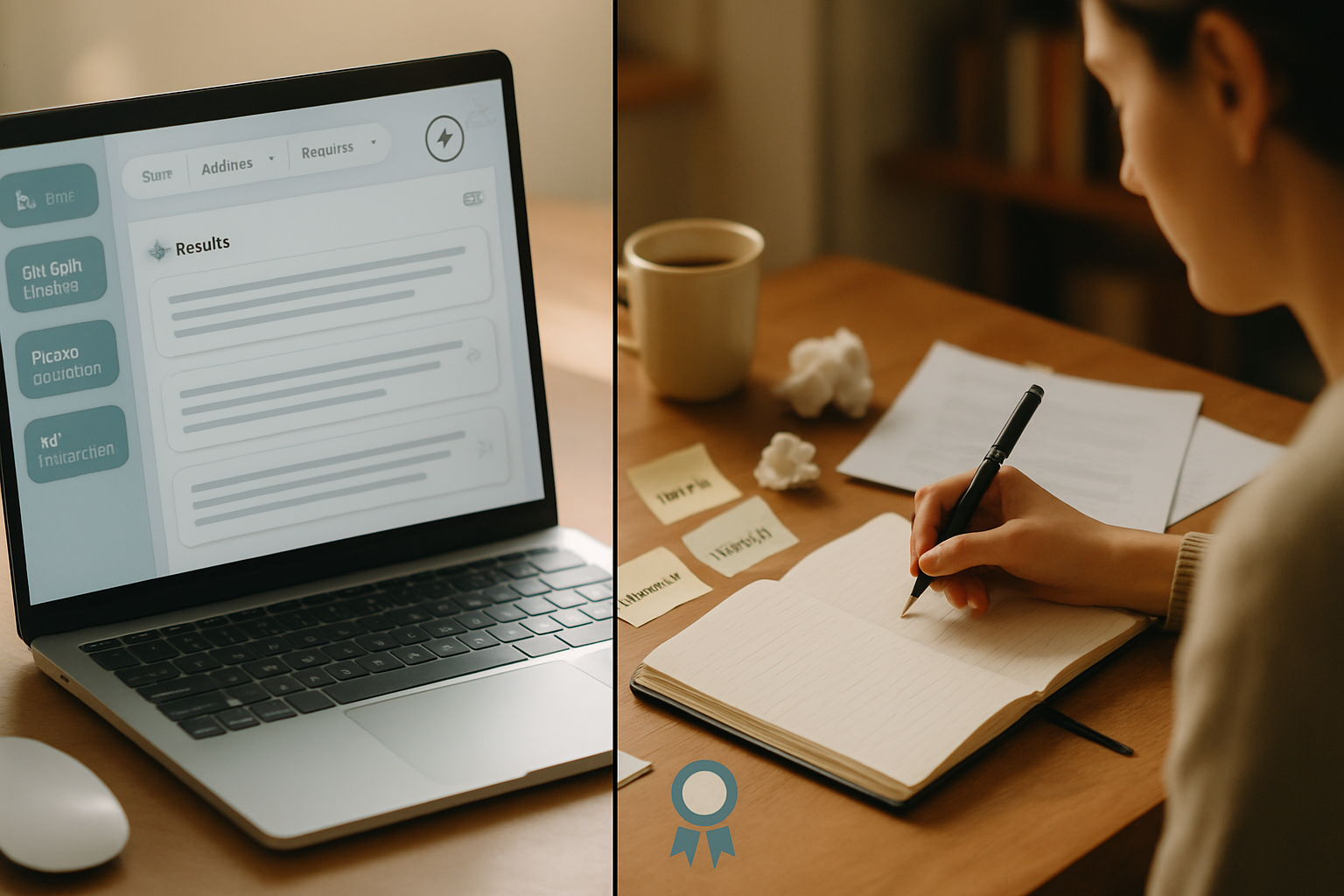
You’ll learn to spot the real strengths and limitations of AI-generated copy (think Copy.ai-style outputs) and compare them to human-written alternatives - side by side. By the end, you’ll know when to use AI, when to rely on people, and how to combine both to scale high-quality content.
Short outcome first: use AI to speed iterations and spark ideas; use humans to give content soul, accuracy, and strategic nuance.
Methodology: how I compared the outputs
I created four common marketing assets and generated Copy.ai-style outputs for each, then produced human-crafted alternatives that a skilled copywriter might deliver. I evaluated each pair across five criteria: relevance, clarity, tone, originality, and conversion potential. Scores are qualitative (Low / Medium / High) with analysis.
Why this matters: tools like Copy.ai accelerate production, but they don’t automatically replace context, brand memory, or deep persuasion techniques. For background on how AI systems are shaped by human feedback, see OpenAI’s discussion of reinforcement learning from human feedback (RLHF) used in model training: https://openai.com/research/rlhf
Example 1 - Short ad headline (social ad)
Context: Paid social ad for “Nimbus Planner,” a premium analog daily planner for busy professionals.
AI-style output (Copy.ai-like):
Find Your Focus With Nimbus Planner - Plan Better, Do More.
Human-crafted alternative:
Finish Today’s Most Important Task - Start With a 5‑Minute Plan.
Evaluation:
- Relevance - AI - High. Human - High.
- Clarity - AI - High. Human - High.
- Tone - AI - Medium (generic). Human - High (specific, actionable).
- Originality - AI - Medium (safe benefit language). Human - High (specific behavior change: 5‑minute plan).
- Conversion potential - AI - Medium. Human - High.
Analysis: The AI headline is competent and usable immediately. The human headline ties to a micro-behavior (5 minutes) and a clear CTA (finish today’s most important task), which tends to increase conversions.
Example 2 - Product description (ecommerce)
Context: Nimbus Planner product page, 50–70 words.
AI-style output:
The Nimbus Planner is a beautifully designed daily planner that helps you organize your schedule, set goals, and track progress. With durable binding and high-quality paper, it’s made to last and to support your productivity every day.
Human-crafted alternative:
The Nimbus Planner gives you a 5-step daily ritual: prioritize one big win, slot three focused work blocks, capture ideas, review progress, and plan tomorrow. Thick, fountain-pen-friendly paper and lay-flat binding mean you’ll actually enjoy opening it. Designed for people who want calm structure, not clutter.
Evaluation:
- Relevance - AI - High. Human - High (more targeted).
- Clarity - AI - High. Human - High.
- Tone - AI - Medium (generic). Human - High (voice and audience).
- Originality - AI - Low-to-Medium. Human - High.
- Conversion potential - AI - Medium. Human - High.
Analysis: The AI version lists standard features. The human version leads with a ritual and customer benefit, building a mental image and differentiating the product.
Example 3 - Marketing email subject + first sentence
Context: Conversion email to trialers who haven’t upgraded.
AI-style output:
Subject: Upgrade to Nimbus Premium and Boost Productivity
First sentence: Unlock more features and stay organized with Nimbus Premium - upgrade today for advanced tools.
Human-crafted alternative:
Subject: Your free trial ends in 3 days - here’s what you’ll lose
First sentence: In three days your trial turns off. That means no more guided daily prompts, no progress snapshots, and no quick export for your planner reviews. Want to keep them? Here’s a 20% upgrade code.
Evaluation:
- Relevance - AI - High. Human - High (timely urgency).
- Clarity - AI - High. Human - High.
- Tone - AI - Medium (promotional). Human - High (urgent, specific, leverage loss aversion).
- Originality - AI - Low-to-Medium. Human - High.
- Conversion potential - AI - Medium. Human - High.
Analysis: The AI email is clear but safe. The human email uses urgency and loss framing and provides a specific incentive - tactics that typically lift conversions.
Example 4 - Blog post intro paragraph (educational content)
Context: Blog about planning techniques for remote teams.
AI-style output:
Effective planning helps remote teams stay aligned. Use a shared planner, set clear goals, and check in regularly to avoid miscommunication. These steps will improve collaboration and keep projects on track.
Human-crafted alternative:
Remote teams drift fast. One missed assumption, one late reply, and suddenly two people are building the same widget. This post walks through a lightweight planning loop we use at Nimbus: a weekly alignment note, three shared priorities, and a 10‑minute sync that solves cross‑team drift before it starts.
Evaluation:
- Relevance - AI - High. Human - High (more visceral).
- Clarity - AI - High. Human - High.
- Tone - AI - Medium (instructional). Human - High (narrative, problem-focused).
- Originality - AI - Medium. Human - High.
- Conversion potential (engagement) - AI - Medium. Human - High.
Analysis: AI gives serviceable guidance. The human writer creates a vivid problem and immediately offers a structured, low-friction solution, encouraging the reader to continue.
What these examples reveal - strengths of AI (Copy.ai-style)
- Speed - Generates dozens of variations in seconds. Great for ideation, A/B test candidates, and breaking writer’s block.
- Consistency - Delivers consistent grammar, neutral tone, and error-free punctuation every time.
- Utility for scale - Useful for product specs, simple descriptions, and first drafts that need volume.
- Cost efficiency at volume - Lower marginal cost per draft than hiring a writer for each micro-copy task.
And the weaknesses - where humans still win
- Nuance and context - Humans remember brand history, subtle positioning, and competitive context. AI can’t reliably maintain that across multiple touchpoints without careful prompting.
- Persuasion and originality - Humans craft fresh metaphors, specific hooks, and behavioral nudges (e.g., scarcity framed ethically) that lift conversion.
- Accuracy and claims - AI may hallucinate statistics or overstate product capabilities. Humans validate facts and legal language.
- Tone depth and voice - A human can emulate a brand voice across long forms and infuse personality, humor, or pathos.
A simple evaluation rubric you can use
Score a piece of copy 1–5 (1 = poor, 5 = excellent) on these five axes:
- Relevance to audience
- Clarity of message
- Emotional resonance / tone fit
- Originality / memorability
- Conversion potential (actionable language)
Use total scores to triage whether a piece needs light edits (AI baseline), substantial rewrite (human), or full human-first creation.
Practical workflows: how to combine AI and humans for the best outcomes
- Idea funnel - Use AI to produce 20 headline candidates. Humans pick the top 3, refine them, and run A/B tests. Fast ideation; human selection.
- First-draft acceleration - Let AI produce a first-pass draft for blog posts or product pages. The human edits for specificity, brand voice, and fact-checks.
- Microcopy production - Use AI for short, non-strategic copy (button labels, meta descriptions), then run periodic human audits for consistency.
- Human-in-the-loop QA - Establish a checklist (brand voice, factual accuracy, compliance) that every AI output must pass before publishing.
- Prompt library & style guide - Build reusable prompts and an authoritative brand style guide. Save the prompts that produced the best results.
These workflows echo human-in-the-loop practices used broadly as AI is integrated into production systems (see how human feedback shapes model behavior in RLHF research: https://openai.com/research/rlhf).
Practical prompt patterns that improve AI outputs
- Be specific - include audience, role, word limit, and desired tone.
- Example - “Write a 50-word product description for a premium planner aimed at busy startup founders. Tone: candid, energetic, slightly humorous.”
- Ask for concrete details - instruct the model to include a ritual, time-savings, or numbers when relevant.
- Request alternatives - “Give me 6 headline options: 2 urgent, 2 benefit-led, 2 playful.”
Prompts matter. The better the prompt, the closer the AI gets to human-quality drafts - but it rarely replaces final human judgment.
Risk & ethics checklist
- Fact-check every claim, date, statistic, or credibility statement.
- Avoid misleading language or exaggerated guarantees.
- Watch for bias and harmful framing; a human reviewer must evaluate sensitivity.
- Track provenance when AI draws on copyrighted training data - ensure originality checks when necessary.
Final recommendations - when to use AI vs. human copywriters
- Use AI when - you need volume, rapid iteration, or to generate testable variants.
- Use humans when - brand voice, legal accuracy, high-stakes persuasion, or complex positioning are involved.
- Best practice - treat AI as a creative assistant, not an author. Humans should edit, contextualize, and own the final message.
Bottom line
AI copy tools like Copy.ai are powerful accelerants. They produce usable, grammatically correct copy fast. But the winning content in marketing is rarely just correct. It persuades, surprises, and fits a specific audience so tightly it feels handcrafted. Combine speed and scale from AI with human judgment to get both Quantity and Quality. That combination - not one or the other - is your competitive advantage.
References
- Copy.ai - product page and examples: https://www.copy.ai
- OpenAI - overview of reinforcement learning from human feedback (how models are shaped by human responses): https://openai.com/research/rlhf