· productivity · 7 min read
Comparing Roam Research to Obsidian: Which is the Future of Digital Notetaking?
A side-by-side analysis of Roam Research and Obsidian that compares features, usability, efficiency, security, and which user types each tool best serves - so you can choose a future-proof notetaking platform.
Outcome first: by the end of this article you’ll know which tool is most likely to serve your long-term notetaking needs - and which one to try first.
Why this matters. Your notes are an investment. They must be discoverable, portable, and fast. Pick the wrong tool and you pay in friction, lock‑in, or lost ideas. Pick the right one and your thinking accelerates.
Quick verdict (TL;DR)
- If you want a cloud-first, minimalist, frictionless environment for networked thinking and collaboration - Roam Research is the simpler win.
- If you want local files, maximum control, a thriving plugin ecosystem, and extensibility at the file level - Obsidian is the more future-proof option.
Both enable the same big idea: linked notes and graph-based discovery. They arrive there from opposite philosophies. Choose the one that aligns with how much control you want over your data and how much configuration you’re willing to do.
Where the two philosophies diverge
- Roam Research (cloud-first, opinionated) - quick setup, built-in query language, block-level references and transclusion, daily notes at the center of workflows. See Roam at
- Obsidian (local-first, extensible) - your notes are markdown files in a folder (a “vault”), with a plugin-driven feature set, offline-first behavior, and deep customization. See Obsidian at
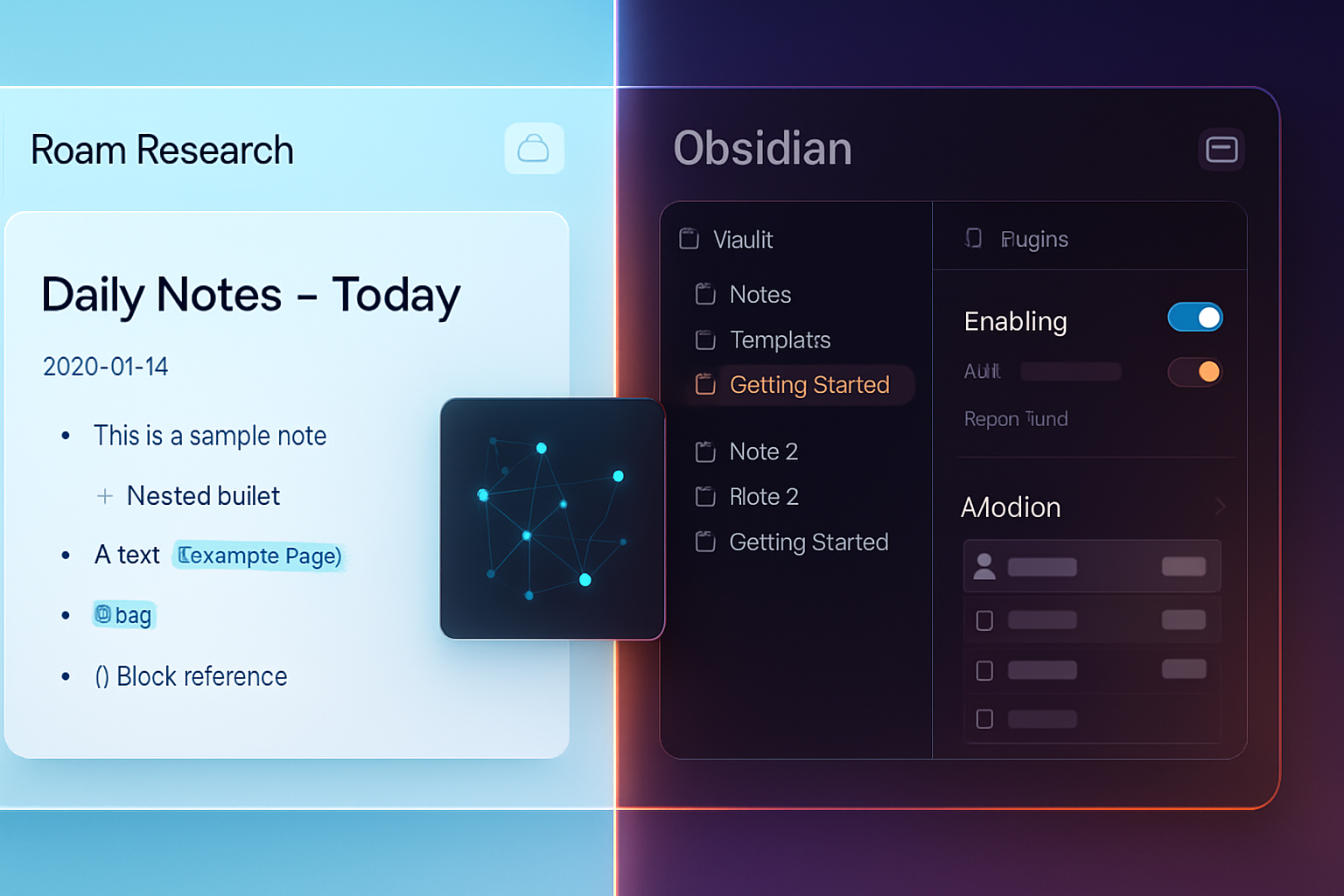
Two routes to networked thought. One gives you immediate structure; the other gives you long-term control.
Feature face-off
Linking and network primitives
- Roam - Block references, block embeds (transclusion), true bi-directional linking baked in. Query language for linking patterns is built-in.
- Obsidian - File-level links and block references. Powerful querying usually comes via community plugins such as Dataview.
Winner: Tie for concepts. Roam makes block-level linking feel native; Obsidian catches up through plugins.
Graph visualization
- Roam - Dynamic graph tied to daily notes and page links, easy to navigate ideas.
- Obsidian - Global and local graphs, highly configurable, can be extended by plugins and filters.
Winner: Obsidian for configurability. Roam for immediate visual simplicity.
Search and queries
- Roam - Built-in query language (Datalog-ish) and powerful block-level queries out of the box.
- Obsidian - Excellent full-text search. Advanced queries via Dataview and other plugins offer richer, custom views.
Winner: Edge to Roam for built-in queries; Obsidian for extensible richness.
Extensibility and plugins
- Roam - Limited public plugin ecosystem historically, more curated features from the core team.
- Obsidian - Large community plugin library and theme ecosystem (see
Winner: Obsidian, decisively.
Offline access and portability
- Roam - Historically cloud-first. Offline support exists but the model centers the hosted graph.
- Obsidian - Local markdown files = you own the data. Offline-first by design and easy to backup or move.
Winner: Obsidian for portability and offline robustness.
Performance and scale
- Roam - Fast for many workflows, but some heavy graphs historically show lag because of a cloud model.
- Obsidian - Local performance scales with your machine; large vaults can be quicker because no network round-trip is required.
Winner: Obsidian typically at scale, Roam for smaller, immediate workflows.
Collaboration and sharing
- Roam - Built for shared graphs and collaborative use-cases earlier; collaboration is a strong point for team use.
- Obsidian - Collaboration has improved (sync and third-party options exist), but native real-time multi-user editing has been slower to arrive and often relies on paid sync features or external tools.
Winner: Roam when synchronous collaboration is primary.
Security and privacy
- Roam - Hosted service - data is stored in their cloud. Check current offerings and privacy policy at
- Obsidian - Local storage by default; optional paid cloud sync is end-to-end (paid sync service available). Local-first = easier compliance with privacy needs.
Winner: Obsidian for privacy-conscious users.
Pricing and total cost
- Roam - Subscription model only, which gives you upkeep and a managed experience.
- Obsidian - Core app is free for personal use. Paid features (Sync, Publish) are add-ons; commercial licensing varies.
Winner: Obsidian for low barrier to entry; Roam for those wanting managed simplicity.
Usability: learning curve vs discoverability
Roam is minimal and focused. You can start typing today and build a daily note habit in minutes. Its approach nudges you into connecting notes through daily pages and inline blocks.
Obsidian is intentionally neutral at first. You open a folder of markdown files and nothing is forced. That’s freedom - and that’s also a ramp. If you want a simple setup, you can have one. If you want power, you unlock a plugin stack and templates and build the workflow.
Short version: Roam is opinionated (faster onboarding). Obsidian is permissive (better for long-term customization).
Efficiency: how fast will you actually get work done?
- Quick capture - Both are fast. Roam’s daily note-first model often wins for quick capture and short-form thinking. Obsidian’s hotkeys and templates close the gap.
- Long-term retrieval - Obsidian’s local files + plugins like Dataview and search give you reproducible, scriptable retrieval.
- Automation - Obsidian’s ecosystem (community plugins, CLI-friendly file setup) is friendlier to automation.
If you measure efficiency as “time to capture an idea,” Roam may be slightly quicker. If you measure efficiency as “time to transform notes into outputs (essays, code, published pieces),” Obsidian often wins because of file portability and export options.
Migration and lock‑in risk
- Roam - Cloud-first design increases the perceived risk of lock-in. Export options exist, but workflows that depend on blocks and transient workspace states are harder to translate.
- Obsidian - Notes are plain markdown files. Migration is straightforward because the files are native and portable.
If you value the freedom to move platforms later, Obsidian is safer.
Which tool for which person? (Practical profiles)
- The daily journalist / fast thinker - Roam. Leans on daily notes and block-level linking to capture momentum.
- The academic / researcher - Obsidian. Needs citation management, plugin-driven workflows, and file portability.
- The writer / book author - Obsidian (for local control and drafts) or Roam (for brainstorming and atomic notes). Many writers combine both: brainstorm in Roam, draft in Obsidian.
- The team that needs synchronous collaboration - Roam for real-time shared graphs (or dedicated team features).
- The privacy-obsessed / enterprise user - Obsidian, local vaults and optional self-managed sync.
These are not absolute rules. They’re signposts.
Decision checklist - pick by answering these questions
- Do you want your notes to live on your machine and be plain files? If yes → Obsidian.
- Do you want a hosted, ready-made networked workspace with minimal setup? If yes → Roam.
- Will you rely on plugins and deep customization? If yes → Obsidian.
- Do you collaborate in real time with a team? If yes → Roam (or look into Obsidian’s paid sync/collaboration options and third-party services).
- Are privacy and long-term portability priorities? If yes → Obsidian.
Answer these honestly. They map directly to the philosophical split.
Migration tips (if you want to try both)
- Start with a small, intentional corpus (a few dozen notes) and replicate the workflow in the other app before moving everything.
- Export regularly. Markdown from Obsidian is native; from Roam you can export markdown/JSON.
- Treat each move as an opportunity to reorganize. Migrations are painful if you move uncurated bulk data.
Final thoughts - and the deeper future of notetaking
Both Roam Research and Obsidian point to the same future: notes that are networked, discoverable, and actionable. They disagree on what should be built into the platform and what should be left to the user.
Obsidian bets on openness: local files, plugins, and community-driven innovation. Roam bets on immediacy: a managed environment that reduces setup and gets you into linked thinking fast.
Which is the future? If “future” means openness, portability, and a platform that can be repurposed in unexpected ways, Obsidian has the upper hand. If “future” means immediate clarity, minimal friction, and collaboration baked into the product, Roam leads.
I’ll leave the final call to you. Pick the tool that matches how much control you want over your data and how much time you’re willing to invest in building a system. Both are important. Both are powerful. And both point in the same direction - toward notes that behave like a thinking partner rather than a filing cabinet.
Now it’s your turn: which platform do you think is better suited to your workflow, and why? Debate starts below.
References
- Roam Research: https://roamresearch.com/
- Obsidian: https://obsidian.md/
- Obsidian community plugins: https://obsidian.md/plugins