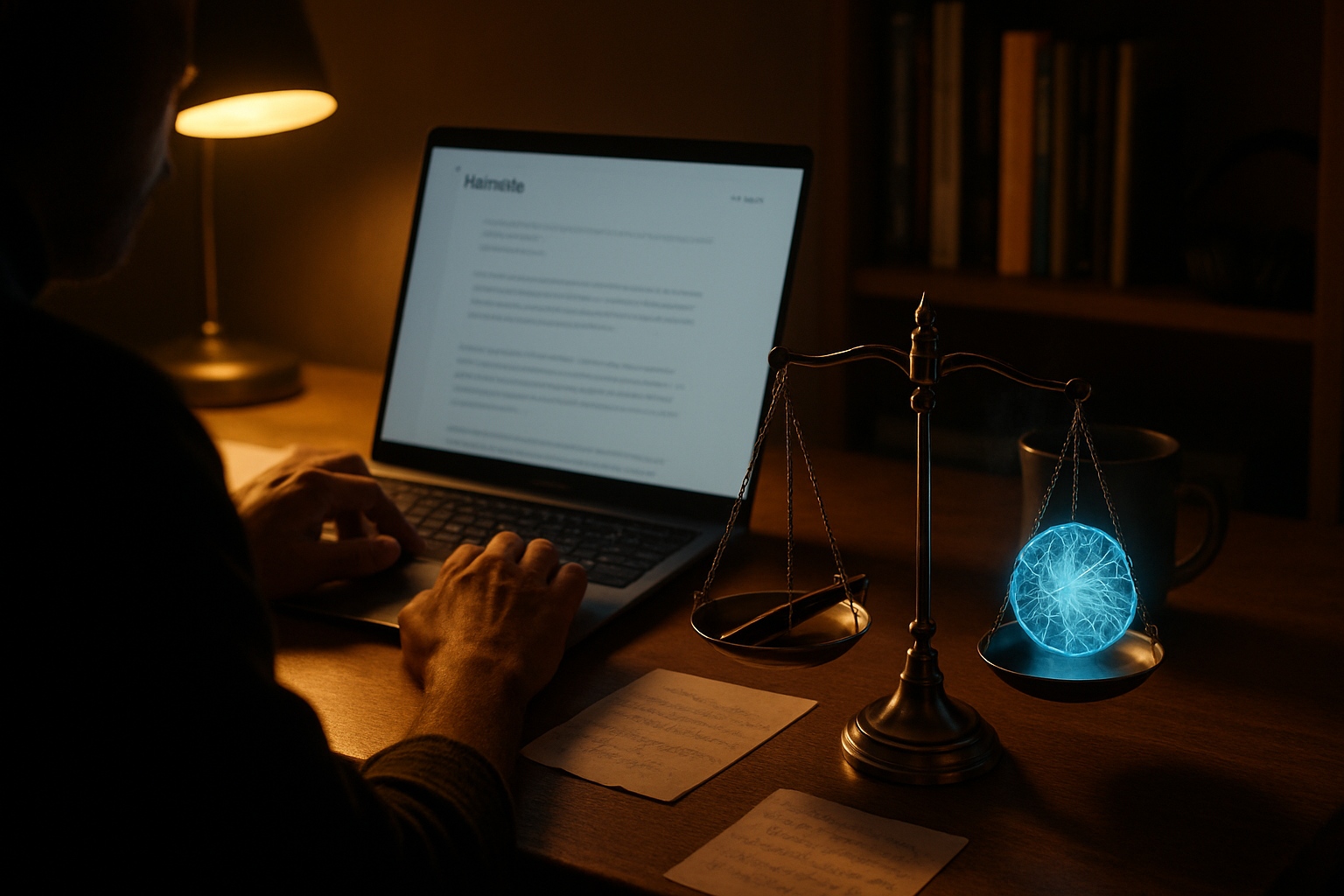
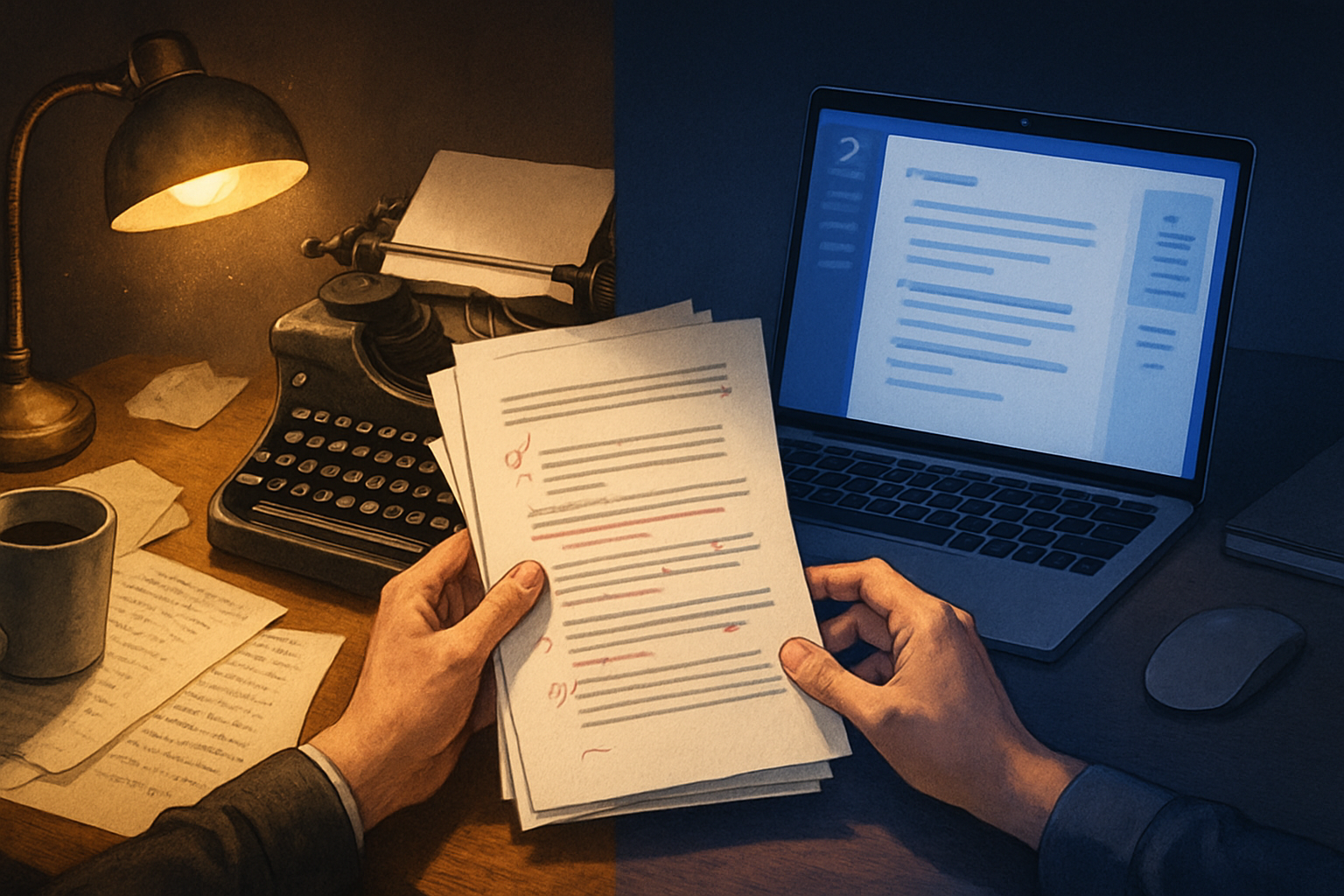
· creativity · 6 min read
The Ethical Debate: Is Using AI for Creative Writing the Future or a Threat?
A deep look at the ethical arguments for and against AI-assisted creative writing - covering legal questions, cultural risks, industry reactions, and practical guidance for writers, publishers and platforms.
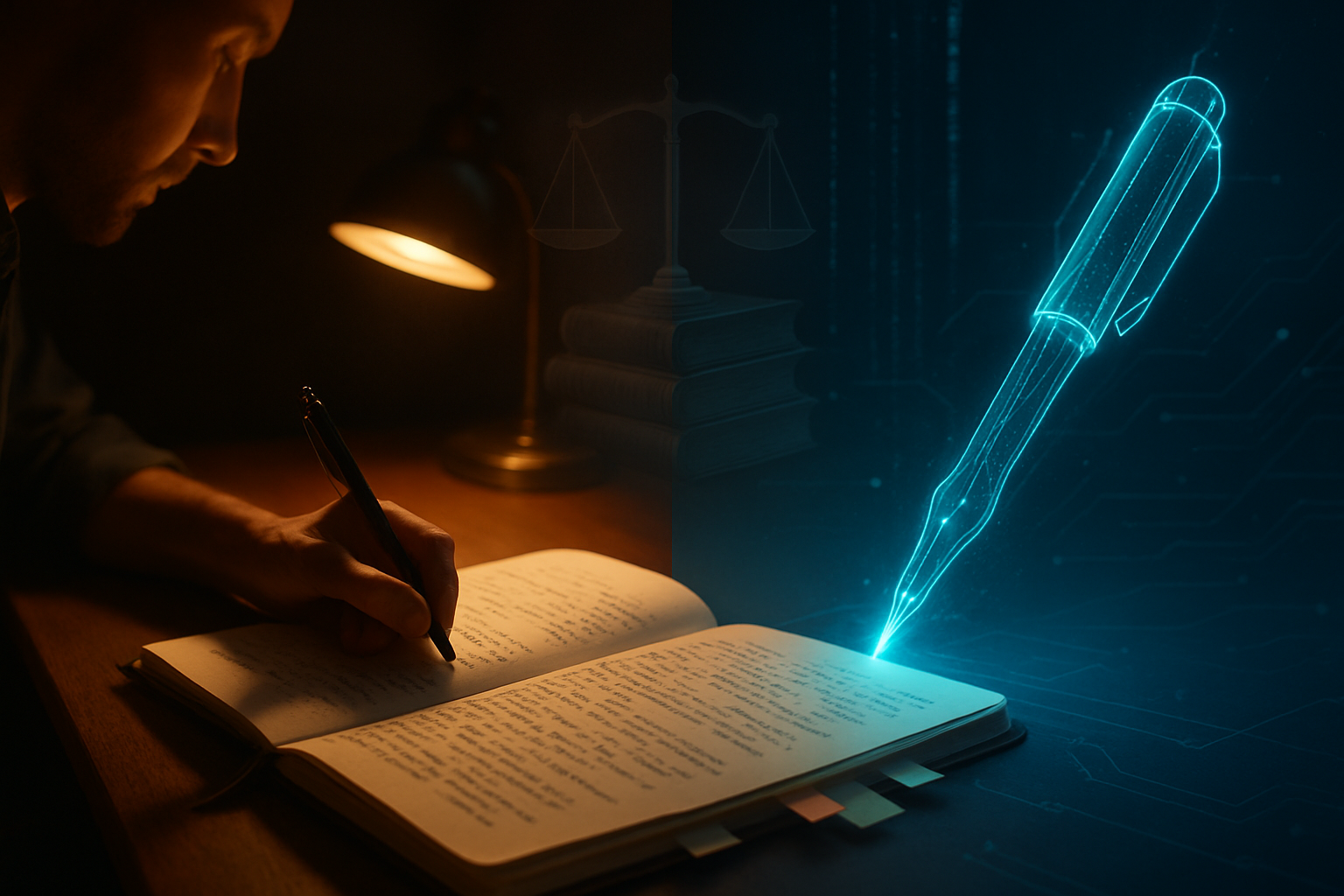
What can you expect from this piece? A clear map of the ethical fault lines around AI-assisted creative writing, a rundown of what experts and institutions are saying, and an actionable checklist so writers and publishers can make better choices today.
Why this debate matters now
AI writing tools are fast, persuasive and increasingly good at producing apparently creative text. They can draft a novel outline in minutes, rewrite a scene, mimic tone, or ghost an article. That promises huge productivity gains. It also raises urgent questions about ownership, consent, cultural diversity and livelihoods.
This isn’t abstract. Contracts, courts and cultural institutions are racing to respond. Your decisions - whether you use these tools, license your work to platforms, or publish with an AI co-author credit - will shape the creative economy for years.
Two broad positions (and where most of the arguments land)
Proponents - AI as amplification. Many technologists and some creators argue that AI is a tool that expands creative options, speeds iteration, and makes writing more accessible to people with limited time or literacy. This camp emphasizes augmentation, human oversight and new forms of collaboration.
Critics - AI as extraction and threat. Authors, rights groups and a number of cultural critics warn that large language models are trained on vast caches of human-created writing without explicit consent or compensation; they worry about job displacement, erosion of individual voice, and the flattening of cultural diversity.
Key voices and policy signals
Authors and rights-holders - The Authors Guild and other organizations have fought back legally and publicly against large tech companies for allegedly training models on copyrighted texts without permission. Their action highlights core concerns about consent and compensation [Authors Guild press release].
International and legal institutions - WIPO and national copyright offices are actively researching how intellectual property laws apply to AI creations and training data, and many governments are publishing guidance or considering legislative updates [WIPO overview] [U.S. Copyright Office AI policy].
Ethics frameworks - UNESCO has published recommendations on the ethics of AI that emphasize human rights, transparency, and cultural diversity - priorities that map directly onto creative practice and policy [UNESCO recommendation].
Technology companies and researchers - Many developers describe their work as creating tools for human creators. But they also acknowledge trade-offs and the practical limits of current detection and attribution techniques.
See also: the UK Intellectual Property Office’s guidance on AI and copyright, which explores who - if anyone - holds authorship when AI contributes to a work [UK IPO guidance].
What’s actually at stake (concrete harms to watch)
Copyright and fair compensation - If models are trained on copyrighted works without licensing, authors can lose revenue and control. Lawsuits and policy responses are attempts to rebalance that dynamic.
Attribution and authenticity - Readers expect to know whether a human or a machine shaped a text. Opaque workflows undermine trust.
Job displacement and labor quality - Routine editorial and content tasks can be automated. That can free writers for higher-value work - or it can commodify writing and squeeze pay.
Homogenization of culture and voice - Language models tend to reproduce dominant patterns in their training data. Without deliberate curation, minority voices risk being underrepresented or mischaracterized.
Misinformation and misuse - AI-generated text can be used to produce convincing propaganda, deepfakes in prose form, or harmful content at scale.
Why some common defenses fall short
“It’s just a tool.” True - but tools reflect their inputs. If the inputs were gathered without consent, or if the tool’s widespread adoption undermines economic structures for creators, the ethical picture changes.
“Detection will solve it.” Current detectors are inconsistent and easily fooled; reliance on them alone is insufficient and can produce false confidence [example of detection limits].
Practical policy options and ethical guardrails
Policymakers, platforms, and creators are exploring several interventions. They vary in feasibility and impact, but together they form a menu of defensible choices:
Dataset transparency and provenance - Requiring platforms to disclose what corpora and licenses were used to train models would improve accountability and enable better consent and licensing models.
Licensing and revenue-sharing - Compulsory licensing or negotiated revenue-sharing schemes for training data could compensate creators while permitting innovation.
Attribution and labelling - Clear, machine-readable labels for AI involvement (from draft to finished text) would protect readers and markets for human-authored work.
Watermarking and provenance metadata - Technical measures that tag AI-generated text could help platforms moderate and publishers verify content origin.
Human-in-the-loop and authorship thresholds - Defining a minimal threshold of human creative input required for human authorship or copyright protection would create legal clarity.
Targeted protections for marginalized cultural expression - Policies that prioritize and protect underrepresented languages and styles can counteract homogenization.
Selected institutional references
- UNESCO - Recommendation on the Ethics of Artificial Intelligence: https://unesdoc.unesco.org/ark:/48223/pf0000379926
- WIPO - Artificial Intelligence and Intellectual Property: https://www.wipo.int/about-ip/en/artificial_intelligence/
- U.S. Copyright Office - Policy pages on AI: https://www.copyright.gov/policy/artificial-intelligence/
- UK Intellectual Property Office - Copyright and Artificial Intelligence guidance: https://www.gov.uk/government/publications/copyright-and-artificial-intelligence
- Authors Guild - press statement on legal action regarding AI training: https://www.authorsguild.org/press/authors-guild-files-lawsuit-against-openai-and-meta/
- On detection limits (example reporting) - OpenAI’s withdrawn AI text-classifier discussion:
What writers, editors and publishers can do right now (practical checklist)
If you’re a writer
- Know your rights - read your publishing and platform TOS closely for clauses about training or dataset usage.
- Negotiate explicit terms - seek clauses that specify whether your submitted text can be used for model training or commercial AI services.
- Keep provenance - archive drafts and timestamps to demonstrate human authorship where needed.
If you’re an editor or publisher
- Demand transparency from vendors about training data and model provenance.
- Consider addenda to contracts that specify compensation or attribution when AI is used to generate revenue.
- Maintain editorial standards - use AI as a first draft tool, not a blind autopilot. Human editorial judgment remains the differentiator.
If you’re a platform or product manager
- Label AI-generated content clearly and make that metadata discoverable via APIs.
- Offer licensing options for creators whose work feeds training corpora.
- Build redress pathways so creators can opt out or claim compensation.
A short roadmap for thoughtful adoption
- Audit - Understand which content and datasets your AI uses. 2. Disclose: Be transparent to creators and audiences. 3. Compensate: Explore licensing or revenue-sharing mechanisms. 4. Evaluate: Monitor impacts on diversity, quality, and livelihoods. 5. Adjust: Change product and policy according to measured harms.
A balanced conclusion - choice frames the future
AI-assisted writing can be a powerful tool for inspiration, access and new forms of collaboration. It can also entrench power imbalances, undercut creators’ livelihoods and flatten cultural variety. The technology itself is neutral; what isn’t neutral is how corporations, courts and societies choose to deploy and govern it.
If we want AI to be the future of richer, fairer creative work rather than a threat, we must demand transparency, fair compensation, responsible labelling, and legal frameworks that respect authorship while enabling innovation. The outcome isn’t preordained. It depends on the ethical choices we make now - and the protections we put in place before convenience becomes the default.